

The most well-known exemplar of the philosophical attitude, Socrates, was put to death for his habits of questioning. On different occasions, Socrates described himself as a “midwife”—assisting his interlocutors through the difficult and painful process of giving birth to thought—and as a “gadfly” (an annoying, biting insect, difficult to shoo away). This latter attribute, in particular, led to the accusations against Socrates—that he corrupted the youth and denied the gods—for which he was convicted and sentenced to drink poisonous hemlock.
But is Socrates’ incessant, unending, often somewhat incendiary questioning the only way we can be philosophers? Can we not find ways to think and behave in society that employ our philosophical habits—without irritating our interlocutors so much they would rather we die?
Barthes’ “Death of the Author”
Why is the philosopher so often found to be such an irritant? Let me draw a comparison to the infamous 1967 essay of Roland Barthes, “La mort de l’auteur”—in English, “The Death of the Author”—Barthes proposes a change in how we view the meaning of written works. The author (as we might infer from the title) is mitigated in importance; it is the reader who constitutes “the space on which all the quotations that make up a writing are inscribed without any of them being lost; a text’s unity lies not in its origin but in its destination.” Meaning is accomplished in the interpreter, rather than the text itself, rather than in the author’s interpretation.
While it is certainly true that the interpreter has an essential role to play in the signification of the written word—indeed, of any communicated word—it is false that the meaning reduces or can reduce to the reader’s coalescence of a text’s diverse layers of signification. Barthes concludes his essay by saying “that to give writing its future, it is necessary to overthrow the myth: the birth of the reader must be at the cost of the death of the Author.”
Barthes’ author, that is, dies in the poststructuralist approach, for the author is nourished by the hope of an audience—of someone to share in his vision. Stealing the meaning, denying that the vision is his, starves the artist more than any financial penury could. (Perhaps this threat is why art today suffers so much.)
But by contrast, the philosopher cannot die the author’s death. His sustenance consists not in the audience that hears him, but the question that unveils—either the truth of what is or the ignorance, and stupidity, of those who believe themselves to know, but do not. The author may be starved by subjectivistic interpretation; the philosopher will only reveal the untenability, the incoherence, the inconsistency, the illogicality of living in such an intellectually inauthentic manner.
Philosophy and the Habit of Charm
But does the philosopher have to be a nuisance? It is a curious thing, when we truly stop and consider the person of Socrates. Though victim of ill-repute granted by underhanded rhetorical manipulations by his enemies, he was also lauded and loved by many; those who knew him best loved him most, and sought to protect him from the fate to which he was condemned.
Is it, perhaps, that Socrates’ analogy of the gadfly was not meant to be taken as so many have—such that the philosopher’s task in life is to gall with his inquiries and insistence? Doubtless, the complacent and unthinking will always find the habits of philosophy an irritant to their ways of living. Those who would reduce the author to his own opinions will unlikely tolerate an incessantly questioning interlocutor who refuses to accept the evacuation of meaning.
But it seems that—just as Socrates himself—we must, to imitate his way of thinking and being, to echo his habits of the philosophical attitude, be also charming.
Join Us
How can we integrate a habit of philosophical reflection into our daily habits? What about our daily conversations? When we find ourselves confronted with an average, everyday question, how do we approach it philosophically without irritating all others involved? What can we do to bring philosophy into our way of living—and share it with others?
Philosophical Happy Hour
« »
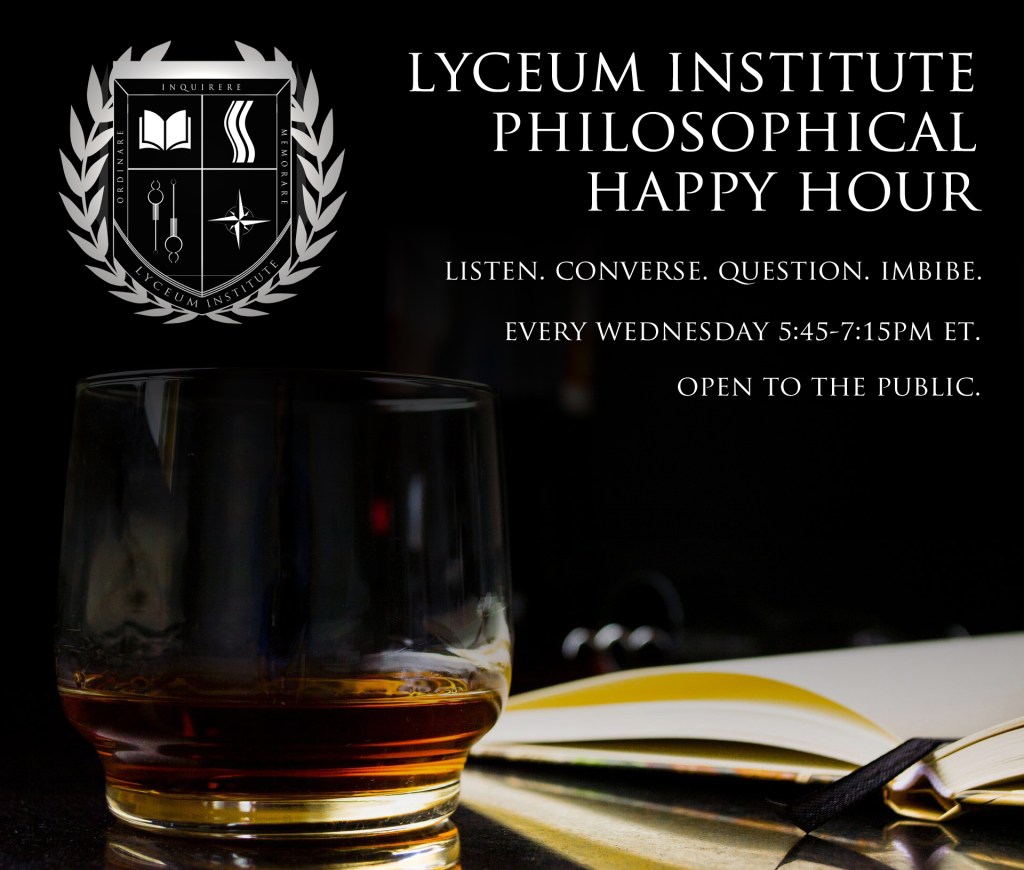
Come join us for drinks (adult or otherwise) and a meaningful conversation. Open to the public! Held every Wednesday from 5:45–7:15pm ET.