

On Habits of Interpretation
A Philosophical Happy Hour on Obstinate Views and the Discovery of Meaning Does it feel sometimes as though the reality you inhabit is not shared with others? A recent Benedictine College commencement speech deemed controversial may well illustrate the point: some saw in these comments (particularly those beginning at 11:49) a demand that women “get […]

Living through the Barbarism
Perhaps this is an odd title—Living through the Barbarism—but it seems that ours is an age of unthinking strife. As a Lyceum Member asks: What is work and what is its purpose? This is something I have been thinking about a lot recently but also as a follow up to our conversation on Private Property […]

On Worldviews and Ideologies
Understanding the World(view) What do we mean by the common term “worldview”? Our English word originates from the German Weltanschauung (from Welt, meaning “world”, and Anschauung, “view”, “perception”, or even “perspective”). Often, the term is used as though it needs no explanation: “That’s your worldview”, “My worldview is…”, “The Roman worldview” or “The Catholic worldview”, […]

Announcing: Trivium 2024
Education in the liberal arts has been neglected in modernity and, when not ignored, derided by the forces of ultramodern thought. The consequences of this dereliction are evident: even those who wish to know often know less than they would like and cannot express themselves as well as they ought. Fortunately, we can retrieve the […]

On the Meanings of “Object”, “Objective”, and “Objectivity”
The word “language” often suffers a confusion in use because of a partial equivocation in signification. Sometimes, we use it to signify the species-specifically human capacity to express semantic depth pertaining to a being known as independent of our cognitive activity; in other words, we use the word “language” to indicate our ability for signifying […]
Discussing Certitude and Intuition
A Lyceum Member writes, proposing a Philosophical Happy Hour topic: What is certitude? What role do signs play in achieving certitude? What role do signs play in intuition? Can I be certain about my mother’s love – is it intuited through signs, or through some other means? The notions of certitude and intuition have played […]

A Philosophical Inquiry into Facts
What is a fact? The English word, used so commonly throughout the modern world, comes from its Latin cognate, factum: an event, occurrence, a deed, an achievement. But since the mid-17th century, under the auspices of the Enlightenment’s so-called “empiricism”, the word has been taken to be a “reality” known as independent of observation. The […]
On Architecture and Order
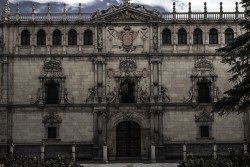
What is architecture? How can we define it? As a human art, it seems that we cannot conceive of what it is fully or properly without efficient and final causes: certainly it is by human beings, and somehow for human beings. But for human beings to do… what? What benefit does the architect render human […]

How and Why We Study Logic
Excerpted from the lectures given to the Lyceum Institute Trivium: Art of Logic Course. “What more can be said about logic?” I am acutely aware, as I pen these words that I pen them not to be read (even if someone other than myself might and does indeed read them), but to be spoken; to […]
On Definition and Language
“Nothing properly signifies itself.” To signify: this is to convey something other, to something other. Signification thereby contrasts with representation by their respective extensions, which can be either “other-representation” or “self-representation”. When you see a portrait, this represents something other than itself, namely, the person portrayed. When you see that person herself, her visible being […]
