
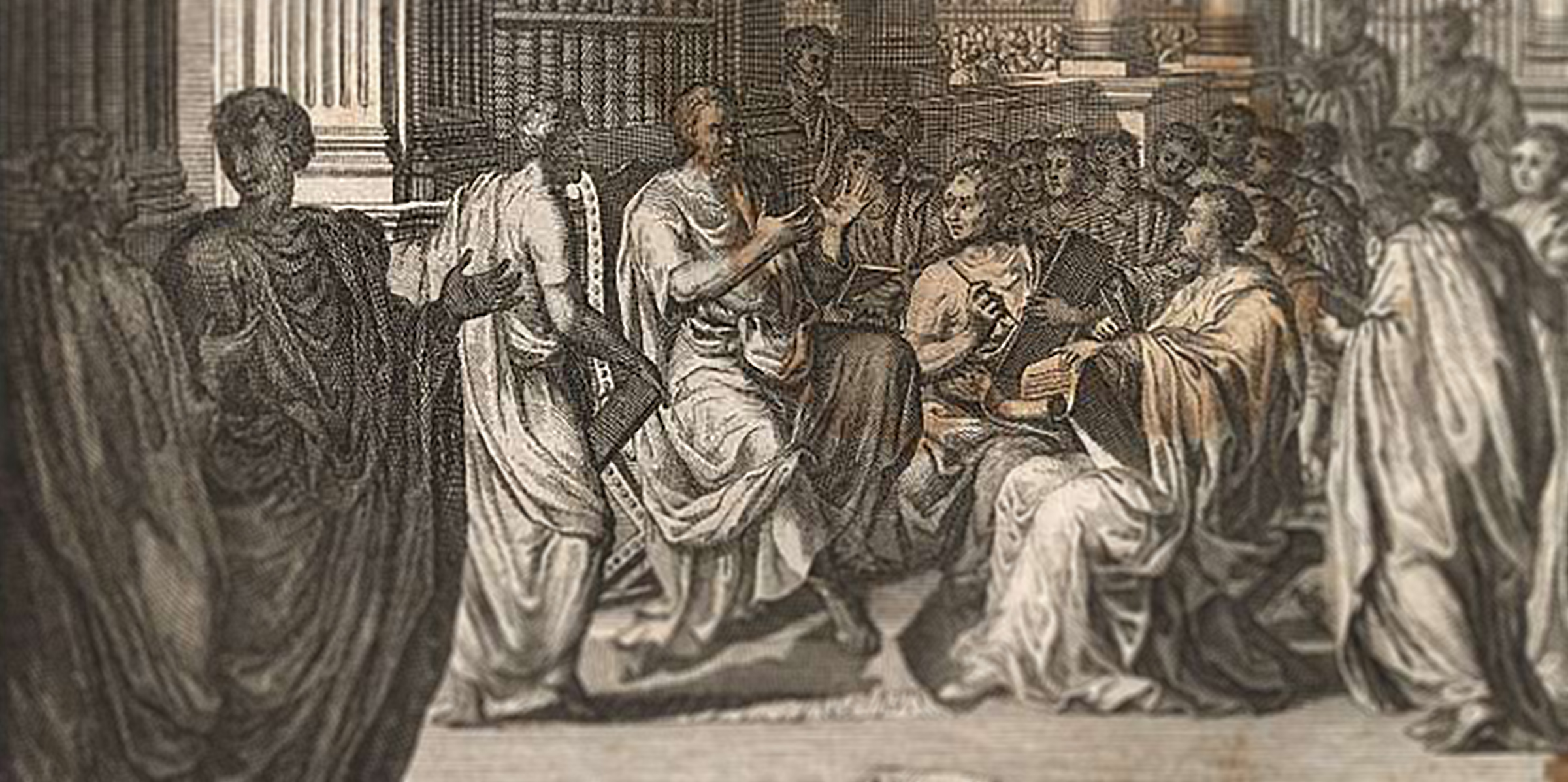
A Philosophical Happy Hour investigating the rhetorical use and fittingness of witness testimony in efforts at persuasion.
Very little of what we know—or believe ourselves to know—comes directly from our own experience. That is, someone might have a kind of local familiarity with things, but he has never seen Africa or Asia, never observed distant planets through a telescope, never read Aristotle in Greek. Belief in each requires trust in the testimony of others, be that in historical records, the word of travelers or scientists, or the fidelity of a translator.
And just think: every historical account of things before our own lives is an account we take on the testimony of some other. The reign of Rameses II? The Roman Empire? The American Revolution? All are taken on the recorded witnesses of others—perhaps a great many others, and many other signs left behind as well, but nevertheless, none are objects of our direct and immediate sensory perception.
The Crisis of Public Trust
Today we find ourselves in an unfortunate position when it comes to the rhetorical efficacy of testimonial evidence. On the one hand, it carries weight, as it always has and always must. There are more important events and happenings than any one of us can witness with our own eyes. But on the other hand, we find these testimonies increasingly suspect and lacking in credibility. Ideological motivation for bearing false witness seems to have increased, while the capabilities of discernment which would make a testimony reliable simultaneously seem to be in decline.
The paradigms under which we judge someone’s credibility, in other words, seem to have become fragmented, broken, and hard to navigate. We have little in the way of public trust. But perhaps we can recover it, at least in part, by thinking about the nature and function of testimony.
Classical Rhetoric and the Role of Testimony
Two great classical sources can help us achieve this goal: Aristotle’s Art of Rhetoric and Quintilian’s Institutio Oratoria.
Both emphasize that testimony seems, contrary to much else in the art of rhetoric, to be “inartificial”. In other words, it is not the invention of the rhetorician, but something relatively “natural”, something that “speaks for itself”. Aristotle, quite interestingly, invokes not only the contemporary witness, but also the “ancient”, i.e., the authorities of the past, as witnesses of a kind.
Quintilian, on the other hand, situates his inquiry precisely in terms of court cases. He looks at not only what is said, but to whom, how, by whom, under what circumstances and motives. Thus his concern is both with how testimony might be undermined, strengthened, used in cross-examination, and the result of its reception.
From both thinkers, we receive insight into something fundamentally true: words signify not just things but the speakers of them. The credibility of those speakers, then, is of paramount importance to the persuasiveness of their words.
Witness to Conversation
Every Happy Hour we have, I propose to you, is a lively and thoughtful engagement! Perhaps then I might persuade you to join us this Wednesday (08 July 2026, from 5:45-7:15+ pm ET) as we tackle these brief readings from both Aristotle and Quintilian and take up the following questions:
- What makes someone credible? Is it principally a matter of known moral character, social standing, expertise, proximity to the event, consistency of story, or some more difficult combination of these?
- Does testimony really “speak for itself”? If testimony is called an “inartificial” proof because it is not invented by the rhetorician, does it nevertheless always require interpretation and judgment on the parts of both giver and receiver?
- Should historical testimony in written or otherwise preserved records be judged differently from contemporary testimony? Does time matter, here?
- What does the most damage to testimonial credibility—motives of profit, ideology, vanity, fear, or incompetence?
- Can public trust be restored without shared standards of credibility? If different groups no longer agree about who counts as trustworthy, what would be required for testimony to regain rhetorical force in public life?
philosophical happy hour
« »
Come join us for drinks (adult or otherwise) and a meaningful conversation. Open to the public! Held every Wednesday from 5:45–7:15pm ET.
mailing list join live
Leave a Reply