
Do you want to know “what is happening”? Cannot resist peeking behind that curtain, over that fence, clicking that link? Join our Philosophical Happy Hour in this member-led discussion of curiosity.
Curiosity
Aristotle starts his Metaphysics with the claim that “All men naturally desire knowledge.” (1.1.1.980a21-2, Tredenick Translation). To modern eyes he seems to be pointing to an admirable curiosity.
Yet, as Christian philosophers noticed, passages of the Bible seem to condemn some sorts of knowledge. St. Paul writes that “Knowledge puffeth up, but charity edifieth” (1 Cor 8:1-2).
When does the pursuit of knowledge go too far and puff us up?
The Vice of Curiosity
St. Augustine worried that much of the knowledge we seek is of this bad sort.
Because of this disease of curiosity you have the various freaks shown in the theatres. Thus men proceed to investigate the phenomena of nature – the part of nature external to us – though the knowledge is of no value to them: for they wish to know simply for the sake of knowing. (Confessions X.35, Sheed translation)
St. Augustine seems to label much of natural science mere curiosity. Pursuing such knowledge is wrong, and if we do so we display the vice of curiosity. Perhaps we should aim, instead, for a corresponding virtue: studiousness, which would keep us focused on knowledge appropriate to our place in the universe.
St. Augustine’s medieval heirs agreed that curiosity was a bad thing. But who was guilty of it? Philosophers routinely accused each other of the vice of curiosity. For example, St. Thomas Aquinas devotes two questions to the vice of curiosity. Yet many thought that St. Thomas’ interest in the pagan philosophy of Aristotle was a paradigm case of this vice.
Cabinets of Curiosities
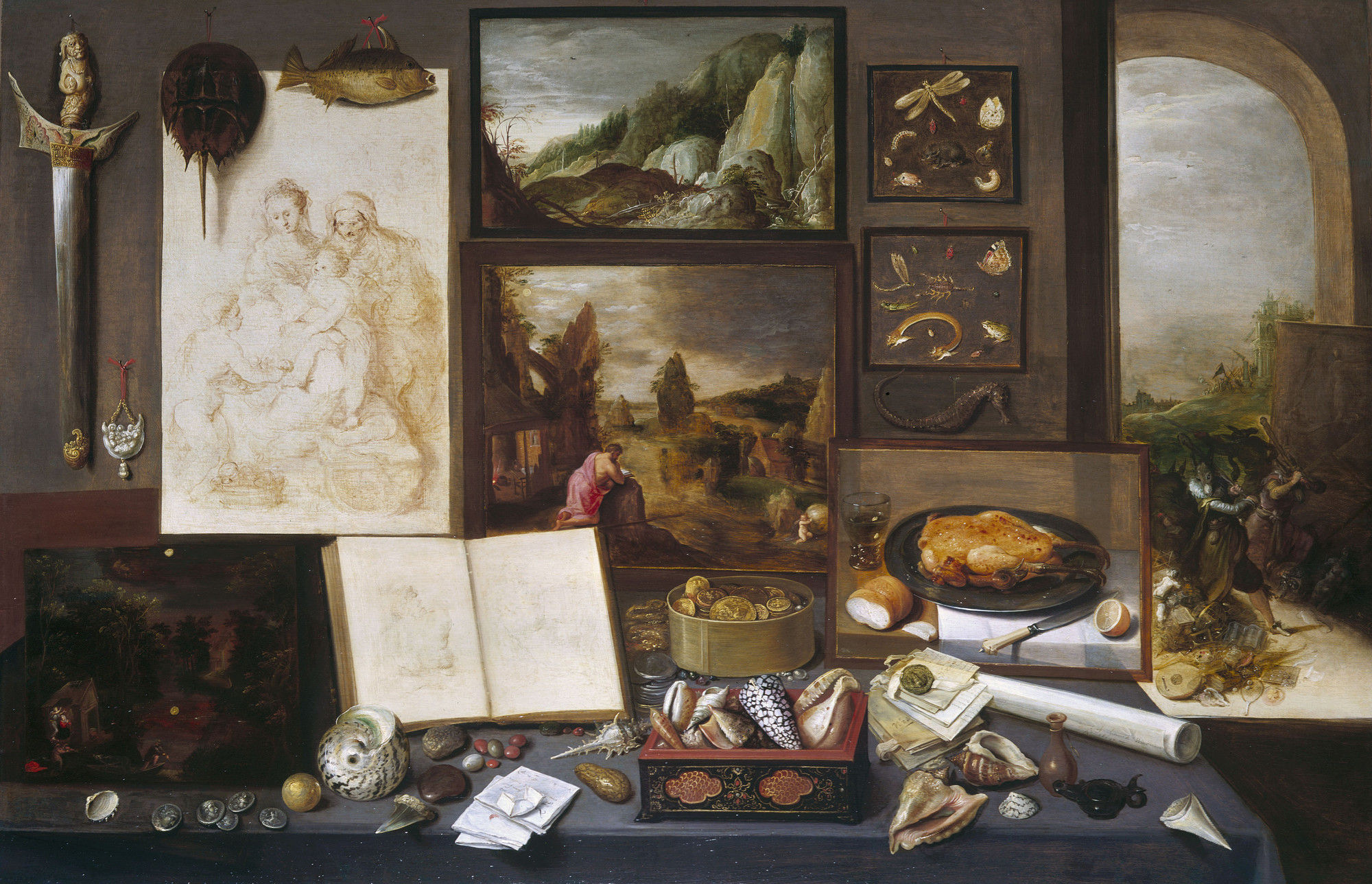
As the middle ages gave way to the Renaissance, curiosity became a guilty pleasure for some. No one wanted to end up like the ultimate curious figure, John Faust, who delved so deep into ‘curious studies’ (magic) that he lost his soul. Yet wealthy men began to build cabinets of curiosities, collections of strange and wondrous and freakish objects.
Perhaps freakish objects could help us understand nature by grasping the exception, rather than the rule. That at least was the view that emerged during the Enlightenment, when philosophers began to rehabilitate the concept of curiosity, now seen as a mark of a well-formed mind. God placed us in this world, philosophers reasoned, and surely He expected us to pry into its workings. And if, as St. Paul says, charity should be our guide, what could be more charitable than the scientific curiosity that drives us to find ways to improve the lives of others: to cure their diseases, speed their travel, improve the improve the yield of their land and so on?
Have We Caught Your Interest?
This Wednesday (14 October 2026, from 5:45-7:15+ pm ET) we shall cast a curious—or, let us rather say, studious—glance at the question of when knowledge should or should not be pursued.
- How should we control the acquisition of knowledge—or should we?
- Does being online foster the vice of curiosity?
- Is any piece of knowledge genuinely useless?
- Is there knowledge we cannot or should not seek—and if so, how would we know to avoid it?
- Does scientific innovation depend on curiosity?
Open to the public
Philosophical Happy Hour
Join a meaningful public conversation every Wednesday, 5:45–7:15 p.m. ET.

Leave a Reply