
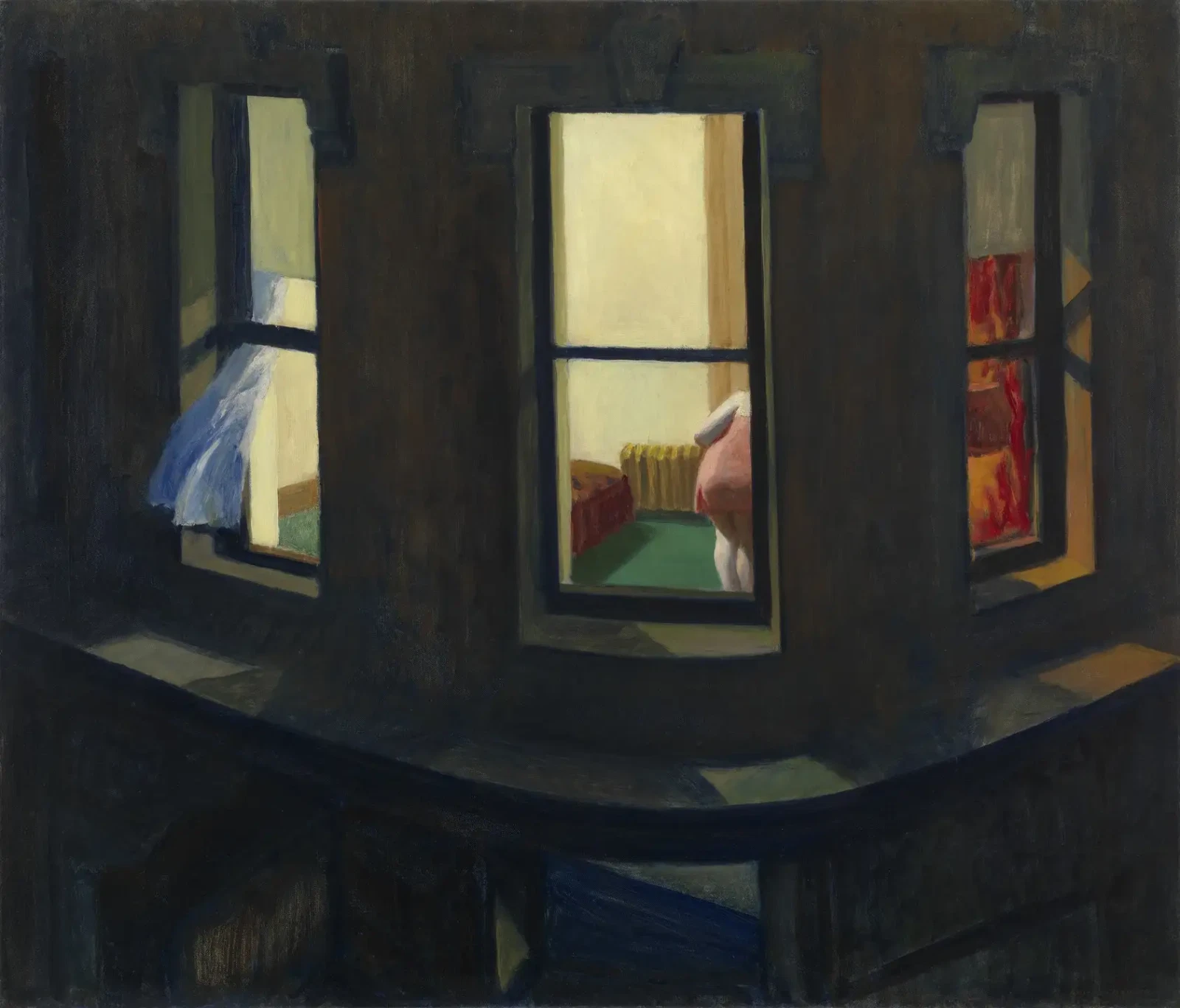
I would dare to say that everyone raised in the Western world has taken “privacy” for granted as a natural right: such that, aside from voluntary participation in the public, each of us is protected from our activities being known. Is this a fairy tale? Join our Philosophical Happy Hour as we pry back the secrets of “privacy”.
Everyone knows Han Christian Andersen’s tale of “The Emperor’s New Clothes”—a memorable story of con artists preying upon common vanity to advance their own financial interests. The most memorable part, of course, is that the emperor, despite the clothiers’ claims, is quite starkly naked; and that everyone else is afraid to acknowledge this fact, fearing it will expose them as incompetent or stupid, until a little boy shouts it out, dispelling the mutual fear.
Allow me here to play the same role: you have no privacy—
(“What?!” we yell, covering up our exposed parts—taking our fingers out of our noses—stopping our undergarment adjustments—turning off the action movie we are watching (or TikTok or Instagram or YouTube) when we are supposed to be working—)
—by default or in principle. That is, I would like to claim, and discuss: is privacy a right? Is it a default or natural condition? Or is it something we have originated only by artifice?
The Origins of Privacy
What do we mean by “privacy”? Generally, it begins as a product of place. One must “create” or find a “private” place. But that is not enough. Human beings are notoriously indefatigable in their curiosity: put up a wall and someone is guaranteed to try finding a way of seeing what is on the other side. We must convince others that they should respect the walls we build and the places we claim as private.
What are the primary reasons behind such an argument? What persuades someone to respect the claims of privacy brought by another? How does technology affect the constructs of privacy we build?
“Private” Interactions Online
I do not recall, precisely, when this thought first occurred to me—the artificiality of the private, the unquestioned nature of its acceptance—but I do recall thinking quite a few years ago that we had all been rather naïve about our use of the internet. That is, with social media, concerns arose over “digital privacy”. Aside from email communiques, most digital activity occurred anonymously. Usernames were fake. Profile pictures were unrelated to the person.
But though the screens and devices may be in our houses and blocked from view of all others, the means of communication—the medium itself, the locus and transmission of the data—is not. Inherently, it is public. Every website you visit, every message you send: these are actions that cannot, as the internet is currently structured, be hidden from every view. There is something misaligned, I would suggest, in trying to build a “privacy” policy into the internet’s use.
A Public Conversation
As always, our Philosophical Happy Hours are open to the public; no bar to entry! So join us this Wednesday (07 October 2026, from 5:45-7:15+ pm ET) as we grapple with the concept of privacy. To stimulate conversation, consider these questions before attending:
- Is privacy natural? Is it fitting to nature? Should we have it—why, for what, to what end?
- Is there a distinction between privacy and secrecy?
- What role, if any, should anonymity play in our communications?
- If everyone already knows that digital life exposes them to observation, why do people continue to act as though they are private? Is this ignorance, resignation, vanity, or some tacit conventional agreement?
Open to the public
Philosophical Happy Hour
Join a meaningful public conversation every Wednesday, 5:45–7:15 p.m. ET.

Leave a Reply