

The Death and Evolution of Education – Part I: Introduction
This is the first in a four-part series on the Death and Evolution of Education, which seeks to explain why we cannot rely upon the university to provide the intellectual formation necessary for the common good, but must “evolve” a new approach to learning. One part will be published each week for the next four […]
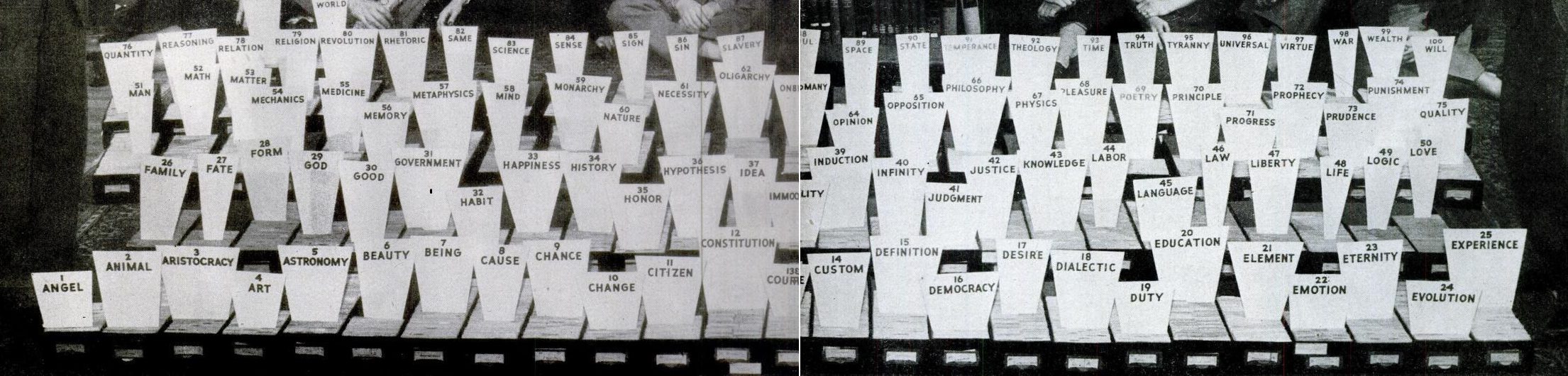
The Future is Technoclassical: Signs of the McLuhan Century (Part Three)
To appreciate how Dewey’s “progressive” educational model and Hutchins’ and Adler’s conservative or “classical” educational model were both inadequate responses to the technological environment of the 20th century – namely, the displacement of the print environment by the electric environment – it will be helpful to make a brief detour into the pioneering media analysis […]
The Future is Technoclassical: Signs of the McLuhan Century (Part Two)
If the difficult and polarizing aphorisms of the media theorist Marshall McLuhan might be appreciated, not as provocative and likely misleading pop cultural soundbites, as they were in the 1960s,1 but rather as foundational insights through which to understand, and act in, the present digital world, how might we begin to formulate the contemporary significance […]
On Progress, Tradition, and Continuity
A philosophical reflection on the tensions between progress and tradition and their resolution through continuity All too often, the notions of progress and tradition alike are swallowed into the ideologies that make of them principles both absolute and opposed to one another. Put otherwise, when progressivism and traditionalism come to prevail, we often lose not […]
On the Significance of Death
An essay on avoidance of thought about the significance of death. By now, even without knowing much about him, I suspect that most people have likely heard of Bryan Johnson, the men employing the most extreme and elaborate (and expensive) anti-aging protocol in recorded history. Johnson believes that, through the use of medicine, scientific understanding, […]
The Future is Technoclassical: Signs of the McLuhan Century (Part One)
It is fairly straightforward (and glum) to observe that our culture’s dependence on, and even reverence for, technological innovation has, in large part, led to the widespread displacement of the humanities by STEM (Science, Technology, Engineering, and Mathematics) in institutions of higher learning. Nevertheless, the perhaps unexpected ways in which our technological culture is implicated […]

A Reflection on Magnificence
When I thanked a donor for making a generous contribution to our Endowment Fund, he sent a simple reply—one I was not expecting. “I’m glad to help and want to thank you for guiding us towards truth and good in a world sorely lacking in both.” I’m probably not the guide the world needs (or the […]

On the Admission of Bad Taste
In lieu of Happy Hour on this Ash Wednesday, a brief reflection on the admission that we have “bad taste” in popular society, and the embarrassments that prevent our honesty. Since it is always unpleasant to have to admit the lack of something that everyone has as a matter of course, and which therefore properly […]

The Depth and Extension of Semiotics [an excerpt]
The following is an excerpt from the lectures for the Semiotics: Thought and Contributions of John Deely seminar offered at the Lyceum Institute. This seminar will be offered again in January (Q1) of 2025. Sign up for our Newsletter to be notified of when to register! Few truths elude our awareness, let alone our full […]

John Deely on the Boundaries of Time
The past is prologue to the present as the present is prologue to the future. But these terms need defining, not so much the term “prologue” as the terms “past”, “present”, and “future”, for they represent the divisions of time as a framework or measure for the pinpointing of events, and so have no fixity […]
