
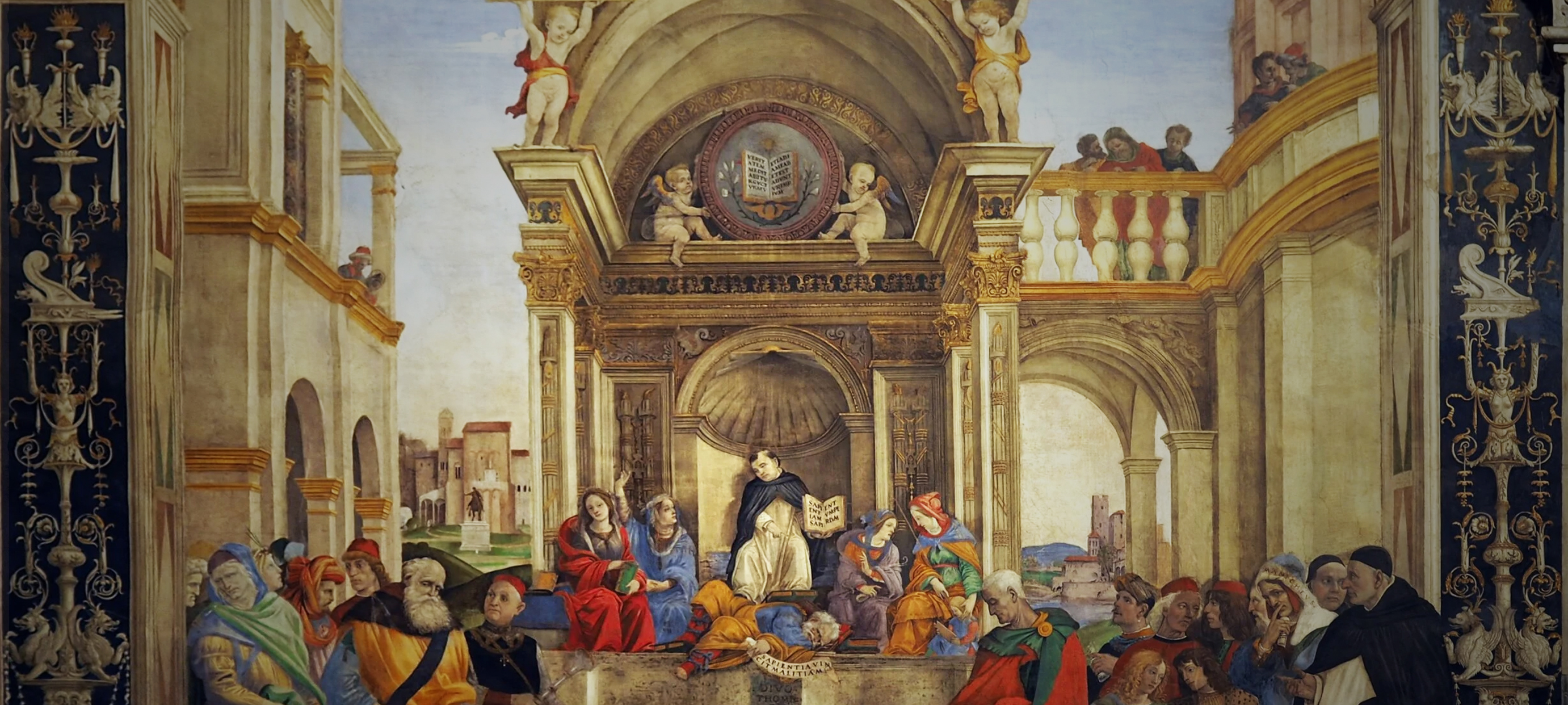
What makes a human being “wise”? What is “wisdom”? Why is it important? In an age of passionate reaction, it seems a virtue all too scarce, and most notably absent from those who govern. Join our Philosophical Happy Hour to discuss its nature and pursuit.
We have more knowledge, expertise, and access to information today than any era previous. And we do not lack for people confident in their possession of these traits or mastery in their employ. Yet for all this knowledge, our world does not seem well-ordered. Many persons, despite their expertise, behave foolishly.
Certainly, information, expertise, and knowledge are goods. But are they somehow incomplete goods, in want of an architectonic virtue to bring them to order?
Practical or Theoretical Virtue?
What do we mean in calling someone “wise”? Is it that he acts well; or that he somehow seems to know all things, somehow?
Aristotle, in his Nicomachean Ethics, Book VI, distinguishes between prudence or practical wisdom (phronesis) and a theoretical or speculative wisdom (sophia). The former, prudence, concerns what must be done, the actions we must take, and finds its highest form, he says, in political prudence: governance over the whole of the city, the polis. Sophia, on the other hand, concerns the highest objects of knowledge, the loftiest truths.
Can a man have phronesis and not sophia, or vice versa, and truly flourish? Are some of us called to one kind of wisdom and not the other? The prudent man might live well… but his life, it seems, might be somehow incomplete: “The wise person (sophos), therefore, ought not only to know what proceeds from the principles but also to attain the truth about the principles. Wisdom, as a result, would be intellect and science, a science of the most honorable matters that has, as it were, its capstone [i.e., is complete].” (Nicomachean Ethics, VI.7, 1141a 17–20.)
Possession, Virtue, or Love?
The Greek word for theoretical wisdom, it cannot escape notice, stands as one of two roots forming the word “philosophy”: the love of wisdom. It was this that Pythagoras famously (at least, per Cicero) called himself, to distinguish from those who called themselves sophos, wise persons. So too, Socrates: for wisdom, as he conceived, was something belonging only to a god, and thus the human could only be a lover of it, not a possessor.
Notably, this contrasts with the just-quoted passage of Aristotle, who names it as an excellence the human person may attain. But what does this mean?

Order and Wisdom
To add one final wrinkle to our considerations: Thomas Aquinas, in part following Aristotle but more principally following Scripture, ordains several tasks which belong to the “office of the wise man” (officium sapientis): to order things; to consider the highest causes and ultimate ends, to attain a knowledge of the highest truth, and to meditate upon it. Or, summarily, “my mouth shall meditate truth, and my lips shall hate impiety.”
Implicit in this twofold task is the suggestion that such concern for the truth and the destruction of falsehoods against it is itself the conduct of ordering. Is there wisdom without order?
Participatory Pursuit
There is something singular in the pursuit of wisdom—something of the flight of the alone to the alone. But the impediments to wisdom, those many obstacles which stand in our way, are not removed by one man’s singular powers. Put otherwise: if we wish to pursue wisdom, we need one another.
So join us this Wednesday (5 August 2026, from 5:45-7:15+ pm ET) as we contemplate together the meaning of “wisdom” and what it means to love it through these and related questions:
- Is wisdom principally practical or theoretical?
- Can a person possess wisdom, or only love and pursue it?
- How does wisdom differ from intelligence, expertise, or knowledge?
- Why does St. Thomas associate wisdom with ordering?
- Is wisdom attained in solitude, through community, or through both?
- What habits and patterns of behavior make wisdom more—or less—possible, more or less concretely realized in our own lives?
Open to the public
Philosophical Happy Hour
Join a meaningful public conversation every Wednesday, 5:45–7:15 p.m. ET.

Leave a Reply