

Medieval Semiotics
Though “semiotics” is a word coined only in the late 17th century—and used consistently and meaningfully beginning only in the late 19th—the study of signs and their actions goes back millennia. During those thousands of years, some of the most important contributions were made during the age often called “Medieval” (though it would be better […]
Ignorance of History and Moral Weakness
“Those ignorant of history are condemned to repeat it” — an oft-iterated maxim that is both often ignored, and, perhaps, misleads. Some history ought, perhaps, to be repeated. (Originality is seldom all that it is praised for being.) Nevertheless, an ignorance of history does have pernicious consequences. It makes us narrow-minded, arrogant, selfish, and ungrateful. […]

Fall 2023: Eugen Rosenstock-Huessy
Rosenstock-Huessy’s is a powerful and original mind. What is most important in his work is the understanding of the relevance of traditional values to a civilization still undergoing revolutionary transformations; and this contribution will gain rather than lose significance in the future. “Rosenstock-Huessy, Who Is He?” Join us for an invigorating seminar that delves into […]

John Poinsot – Cursus Theologicus
Cursus Theologicus The work of John Poinsot, also known as Joannes a Sancto Thoma (though as John Deely noted, his name has often been given in many other variations, across English, Portuguese, Italian, Spanish, French, and Latin), has long been the victim of great neglect. His Cursus Philosophicus was critically-edited and published in the 1930s under the […]

Falling in Love with an Easy Life
An excerpt from the concluding pages of Solzhenitsyn’s Gulag Archipelago, Part II, recollecting time spent in the Butyrki transit prison of central Moscow. In particular, he here notes a contrast with the prisoners of his own generation—most of whom fought in the Second World War with some pride in their service for the Motherland—and the […]

I.M. Bochenski on the Concept of Formal Logic
Preliminary definition of the subject matter of the history of logic is hard to come by. For apart from ‘philosophy’ there is perhaps no name of a branch of knowledge that has been given so many meanings as ‘logic’. Sometimes the whole history of philosophy, and even knowledge in general, has been thus named, from […]

John Henry Newman in Four Books
It has often been suggested, and not without ample reason and evidence, that the importance of a great thinker never finds itself as potently realized during the thinker’s own lifetime. The significance of truly great thoughts, that is, take not only decades but centuries to unfold. Thus, when it is claimed that John Henry Newman […]
The Challenge of Chivalry
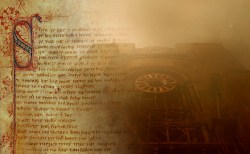
Written by an anonymous author in the late 14th century, Sir Gawain and the Green Knight continues to entice the human spirit: drawing us toward something grand, mysterious, and—perhaps most of all—towards the betterment of our own virtue. The titular hero, captured in poetic verse, exemplifies chivalry. Sir Gawain demonstrates courage, piety, courtesy, honesty, honor, […]

POSTPONED ⚘ Anthroposemiosis, Augustine, Poinsot, Peirce and Deely | Javier Clavere
Dear all, Due to unforeseen yet gratifying work commitments, Professor Doctor Javier Clavere requested a postponement of the lecture entitled “Anthroposemiosis, Augustine, Poinsot, Peirce and Deely and the Production of Human Knowledge and Experience”, the date of which shall be made public as soon as possible. To all of you we beg for understanding, and […]

Marshall McLuhan on the History of the Trivium
…the history of the trivium is largely a history of the rivalry among them for ascendancy. Ancient grammar was at odds with the dialectics of Plato and, especially, of Aristotle, as the art of interpreting phenomena. As the method of patristic theology, grammar enjoyed uninterrupted ascendancy until the revival of dialectics by Gerbert, Roscellinus, and […]
