

Dr. Daniel Wagner on the Human Good
Our Faculty Fellow and Associate Professor, Director of Catholic Studies, and Chair of Philosophy as Aquinas College in Grand Rapids, MI, was on the Acton Line podcast of the Acton Institute last year (but just let us know recently!). Give a listen here: Reason, nature, and the human good – YouTube
On the Purposes of Art
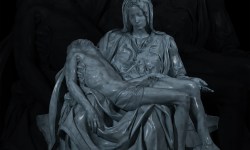
What is the purpose of art? It is not a new question. To the contrary, it resides among the oldest of questions. Some may despair of a meaningful answer, given the ancient age of a question yet still be asked—and, at times, asked as though nothing said in the millennia before us has given satisfaction. […]
Questions of Tolerance
Today’s Philosophical Happy Hour concerns the issue of “tolerance”. As Geoffrey Meadows, who will be leading the discussion, writes: Tonight I thought we might discuss the definition, limit, and moral status of “tolerance,” since our discussion on kindness uncovered this underlying sensibility of our age. Perhaps a series of guided questions can get us started […]
The Moral Noetic of the Natural Law
Law: the word, to many, conjures images of the courtroom or a legislature—ponderous tomes of tediously-written jargon rendering a complex web of oft-arbitrary-seeming stipulations and impingements. So prevalent is this imagery that to speak of the “natural law” sounds often like a mere metaphor. Exacerbating this “metaphorical” tenor of the phrase has been its use […]

Ravaisson on the Formation of Second Nature
As soon as the soul arrives at self-consciousness, it is no longer merely the form, the end or even the principle of organization; a world opens within it that increasingly separates and detaches itself from the life of the body, and in which the soul has its own life, its own destiny, and its own […]

Solzhenitsyn on Ideology
Aleksandr Solzhenitsyn (11 December 1918—2008 August 3) was a prolific author, primarily of fiction, whose account of suppression, corruption, and evil in the USSR’s prison system—the Gulag, through which uncountable millions were moved over the decades—exposed the deep rot at the core of socialist thinking. Here we present an excerpt from the first of three […]
What Is Wrong with the World?
“What’s wrong with the world?” Countless thinkers have asked this question, especially over the past century-plus, and they have asked it over and over again; to the point that few in recent years seem to ask it any longer, even for the purpose of adopting the thinnest veneer of rhetorical posturing. No. Today, almost everyone […]

[2023 Winter] Ethics: Virtue
What does it mean to be good as a human being? Modernity, all too often, has treated this as a problem to be solved. That is, we tend to view moral failings as simply in need of the right solution, the right education, the right program. Morality, however, is something that belongs to the individual. […]
No Freedom without Purpose
Musings derived from recent Lyceum Institute conversations concerning language. It is an oft-stated distinction, and with good cause, that “freedom” may be said in two ways: either a kind of negative freedom, that is, a freedom belonging to self-determining agents in the absence of restraint (“freedom from”); or a kind of positive freedom, namely, the […]

[Summer 2022] Philosophical Thought of Garrigou-Lagrange
Fr. Reginald Garrigou-Lagrange, styled by certain parties as the "Sacred Monster of Thomism," taught at the Pontifical University of St. Thomas Aquinas (the "Angelicum") in Rome for a long career of over fifty years. Although he is normally understood to be a conservative Roman theologian of his period, an honest assessment of his work shows...
