

Total (Moral/Human) Annihilation
The following is excerpted from Lewis Mumford’s 1961: The City in History, c.18, “The Myth of Megalopolis”, an important source in our upcoming Difficulties of Technology seminar. Here we explore the themes of “total human annihilation”—particularly in its moral dimension. Naïve Functionaries of Annihilation Much of the thought about the prospective development of cities today […]
Lying and Truth as Accomplishments
The following is excerpted from a presentation given by John Deely on 1 March 2014 at the 37th Annual Meeting of the American Maritain Association. What Makes Possible both Lying and Truth as Human Accomplishments Comment “Listening to Maritain on the subject of sign as treated by Poinsot…” We should, in fact, listen to John […]

Language as Craft: Building Blocks for Communication
The following is a reflection authored by Columbanus Fellow Sneha Jain. Language’s fundamental purpose is to communicate the intention of the speaker or writer. By nature, however, language is conventional, which can confuse or obscure the desired message. In other words, language relies upon stipulation, and it is often assumed—whether rightly or wrongly— that the […]

“From Rational to Semiotic Animal”
An extract from Deely 2006: “Semiotics, History of” in Encyclopedia of Language and Linguistics, Second Edition (London: Elsevier) v.11: 216–29. The thinkers of the Latin Age, inspired by Aristotle, liked to distinguish between remote and proximate potentialities. Thus, awareness or knowledge of the action of signs was no more than a remote possibility the long […]

The Standard of Truth
Often we have been told that the universe revealed to us by our eyes and ears, our taste and touch, gives a false presentation to the underlying reality: that, beneath the sensory lies a reality discerned through specialized instrumentation and intelligible only at the mathematical level. Sir Arthur Eddington quite famously proposed that there is […]

C.S. Peirce on “Sham Reasoning”
An intellectually vigorous soul does not seek justification of its conclusions, but the truth of the matter. All too often, however, our reasoning is applied not to the discovery of inquiry’s foundations but thrown into the midst of a battle. This today is what we face: either you are with or against, an ally or […]

The Relationship between Logic and Rhetoric
Oftentimes, a student beginning in logic believes that this study will enable him or her to win arguments, convincing interlocutor and audience alike. But even after a great deal of study and many attempts, expectations and reality remain far apart. Others, particularly in this “post-truth” world where facts seem to account for little but favorable […]

Walls of Glass
Metaphors of Personal Identity in Derek Parfit and Teresa of Ávila Personal identity over time is an idea derided by analytic philosophy. Hume began the process of debunking the person, or self, as “nothing but a bundle or collection of different perceptions.”[1] The demolition job concluded in 1984, with the publication of Derek Parfit’s Reasons […]
Bellarmine on the Defeat of the Devil
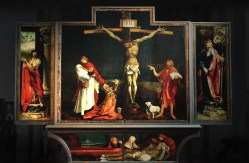
In his meditations upon the seven last words of Christ, spoken from the cross, St. Robert Bellarmine (1542–1621) offers a series of reflective considerations most apt for this season, not only for the Christian, but for all who would think carefully on the meaning of life, death, and the universe. Particularly poignant in this, a […]

Language, Non-Existent Objects, and Semiotics
In the 19th and 20th centuries, a fever for scientific explanation of all phenomena gripped many an intellectual. Language, however, has proved resistant to the methods of modern science. Too many aspects of our experience prove irreducible to the empiriometric approach successful in disciplines such as chemistry or biology. This resistance vexes the reductionist’s mind. […]
