
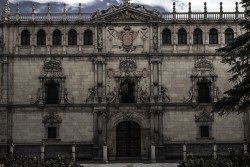
On Architecture and Order
What is architecture? How can we define it? As a human art, it seems that we cannot conceive of what it is fully or properly without efficient and final causes: certainly it is by human beings, and somehow for human beings. But for human beings to do… what? What benefit does the architect render human […]

Falling in Love with an Easy Life
An excerpt from the concluding pages of Solzhenitsyn’s Gulag Archipelago, Part II, recollecting time spent in the Butyrki transit prison of central Moscow. In particular, he here notes a contrast with the prisoners of his own generation—most of whom fought in the Second World War with some pride in their service for the Motherland—and the […]
John Deely on the “Practical Value” of Logic
Peirce rightly speaks of the practice of boasting of the utility of this or that science as a “nauseating custom” (1898a, alt. ver. : CP 1.667). This is because the practice in question almost invariably is indulged in for purposes quite unrelated to the true character of the science in question or to the advance […]

John Deely on Deconstruction
What is deconstruction? As John Deely makes clear, deconstruction is a tool rather than a system, and if made a system, becomes a dead-end.

I.M. Bochenski on the Concept of Formal Logic
Preliminary definition of the subject matter of the history of logic is hard to come by. For apart from ‘philosophy’ there is perhaps no name of a branch of knowledge that has been given so many meanings as ‘logic’. Sometimes the whole history of philosophy, and even knowledge in general, has been thus named, from […]
Ravaisson on the Formation of Second Nature
As soon as the soul arrives at self-consciousness, it is no longer merely the form, the end or even the principle of organization; a world opens within it that increasingly separates and detaches itself from the life of the body, and in which the soul has its own life, its own destiny, and its own […]
Solzhenitsyn on Ideology
Aleksandr Solzhenitsyn (11 December 1918—2008 August 3) was a prolific author, primarily of fiction, whose account of suppression, corruption, and evil in the USSR’s prison system—the Gulag, through which uncountable millions were moved over the decades—exposed the deep rot at the core of socialist thinking. Here we present an excerpt from the first of three […]

On the Authority of Media
While researching a variety of topics at conveniently-intersecting purposes, I came across this wonderful article from Elliot Gaines (author of 2011: Media Literacy and Semiotics), in which he explains how we need media criticism in order to avoid having our opinions settled for us by means contrary to reason in fact, even if many deem […]

John Deely on Semiotics and Logocentrism
Within current philosophy, David Clarke has made a belated attempted to define semiotic itself in the restrictive terms already established as proper to semiology: an “attempt to extend analogically features initially arrived at by examining language use to more primitive signs, with logical features of language becoming the archetype on which analysis of these latter […]
Henry Osborn Taylor on the “Middle Ages”
Preface to the First Edition, 1911: The Medieval Mind (2 volumes), Vol.I, xi–xiv: The Middle Ages! They seem so far away; intellectually so preposterous, spiritually so strange. Bits of them may touch our sympathy, please our taste; their window-glass, their sculpture, certain of their stories, their romances—as if those straitened ages really were the time […]
