
A Philosophical Happy Hour questioning the essence and reanimation of Stoicism, Ancient and New.
“Demand not that events should happen as you wish”, writes the Stoic philosopher Epictetus (c.50–135ad), “but wish them to happen as they do happen, and you will go on well.”[1] Is this profound wisdom—or a bumper-sticker philosophy? Or consider what this from the Philosopher-Emperor Marcus Aurelius (121–180ad): “Through not observing what is in the mind of another, a man has seldom been seen to be unhappy; but those who do not observe the movements of their own minds must of necessity be unhappy.”[2] Was the Emperor advocating “mindfulness”—or something more?
The twentieth and early twenty-first centuries have seen a society perfused with neuroses. Communication technologies made the world smaller and faster, and this contraction seems to have produced an endemic state of anxiety. It may, therefore, seem little surprise that a renewed interest in Stoic philosophy began in the late 1990s or that it certain elements of its thinking have found adherents in high-pressure fields, especially in Silicon Valley and among those most intimately acquainted with technological advance.
But what does it really mean to be (a) “Stoic”? What is Stoicism as a school of thought?
Ancient Schools of Stoicism
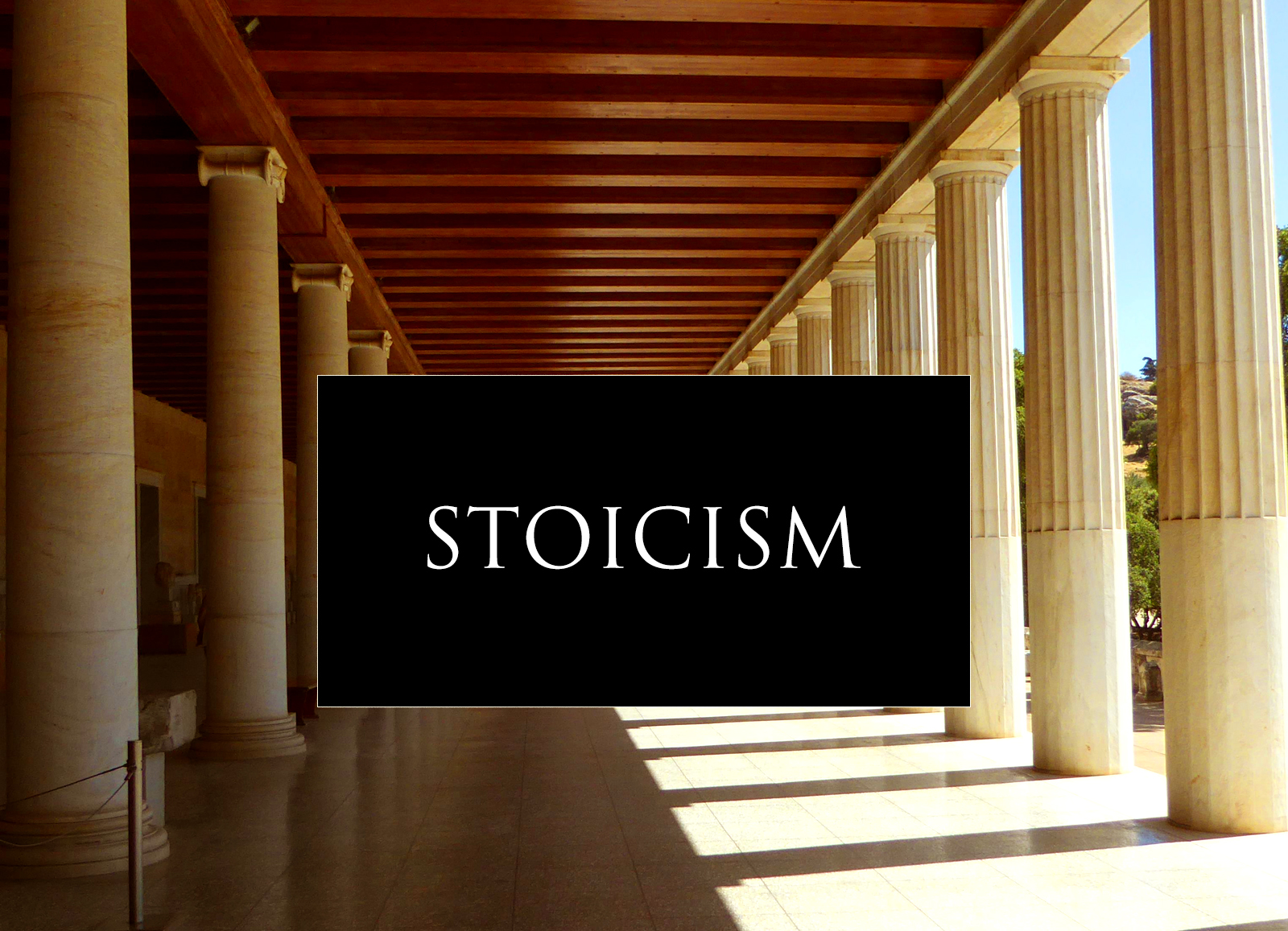
Few situations in history seem as conducive to philosophical thinking as that of ancient Athens. Of course, the polis was not always kind to its seekers of wisdom—putting Socrates (c.470–399bc) to death and causing Aristotle (384–322bc) to flee for fear of the same—but the life of the mind undoubtedly found in Athenian soil a place to set down roots. Not only did Socrates inspire Plato (428–347bc) to found his Academy there, and not only did Aristotle establish his Lyceum outside its walls, but so too Zeno of Citium (c.334–262bc), after studying amongst Cynics and Platonists, Megarian philosophers and dialecticians, founded the school of Stoicism (so called because he taught in the Stoa Poikile, or northside colonnade of the Agora) in roughly 300bc.
While none of Zeno’s writings have survived (nor have any complete texts from early Stoic thinkers), his influence was felt, as evidenced by the quotes with which we began, for hundreds of years, deeply affecting not only the Grecian but also the Italian peninsula. One finds the Stoic cast of mind not only in Aurelius but also Seneca the Younger (c.4–65bc), for instance; and one can see that, though more of a Platonist, Cicero (106–43bc) too adopts many a premise in his thought from the thinkers of the Stoa.
Though best known as an ethical philosophy, concerned with the regulation and control of the passions, Stoicism also developed a complex and rich logic. Where Aristotelian logic focuses more centrally upon the term and the demonstrative qualities of the categorical syllogism, the Stoics attended principally to the proposition—and especially to the “hypothetical” proposition.[3] Do we misunderstand the ancient Stoics if we fail to understand the connection between their logic and their ethics—and, indeed, their metaphysics?
Contemporary Stoicism: Renewal or Fraud?
Look again at the quotes from Epictetus and Marcus Aurelius with which we began, and one can easily see the appeal to today’s chaotic, neurotic, anxiety-filled world. They are hardly statements out of the norm for the Stoic. Consider:
- “Natural abilities do not respond well to compulsion; when Nature is in opposition, labour is fruitless.” – Seneca the Younger, On the Tranquility of the Mind.
- “Do not be whirled about, but in every movement have respect to justice, and on the occasion of every impression maintain the faculty of comprehension.” – Marcus Aurelius, Meditations.
- “Let death and exile, and all other things which appear terrible, be daily before your eyes, but death chiefly; and you will never entertain an abject thought, nor too eagerly covet anything.” – Epictetus, Enchiridion.
No doubt, there resonates a certain manliness in these exhortations. One sees a call to fortitude and reason; for not only an acceptance of that outside one’s control but a firmness in controlling what one can. Contrary to the hustle and bustle, the constricting noose of urgent worldly success, it appears calm. Measured. The Stoic does not have to be something else. He does not have to impress. He is not flustered by the obstacle—in fact, he welcomes it and finds success in confronting and overcoming the difficulty.
But is this stern-faced doctrine of self-control, of self-reliance, of disaffection truly replicate the Stoicism of antiquity? Or is it merely another effort at coping with the modern world? Is it wisdom, or merely another modern therapeutic to mask our disordered souls?
Lessons from the Stoics
Join us this Wednesday (28 May 2025 from 5:45–7:15+ PM ET) as we strive to discern the essence and importance of Stoicism, discover what lessons it may truly teach us, and distinguish between its authentic imitation and inauthentic appropriation.
philosophical happy hour
« »
Come join us for drinks (adult or otherwise) and a meaningful conversation. Open to the public! Held every Wednesday from 5:45–7:15pm ET.

[1] Epictetus / Arrian c.125ad: Enchiridion, VIII.
[2] Marcus Aurelius i.161-180: Meditations, II.8.
[3] It must be noted, of course, that no original texts of Stoic logic remain extant, and the knowledge of their developments comes entirely through other ancient sources.
No responses yet