
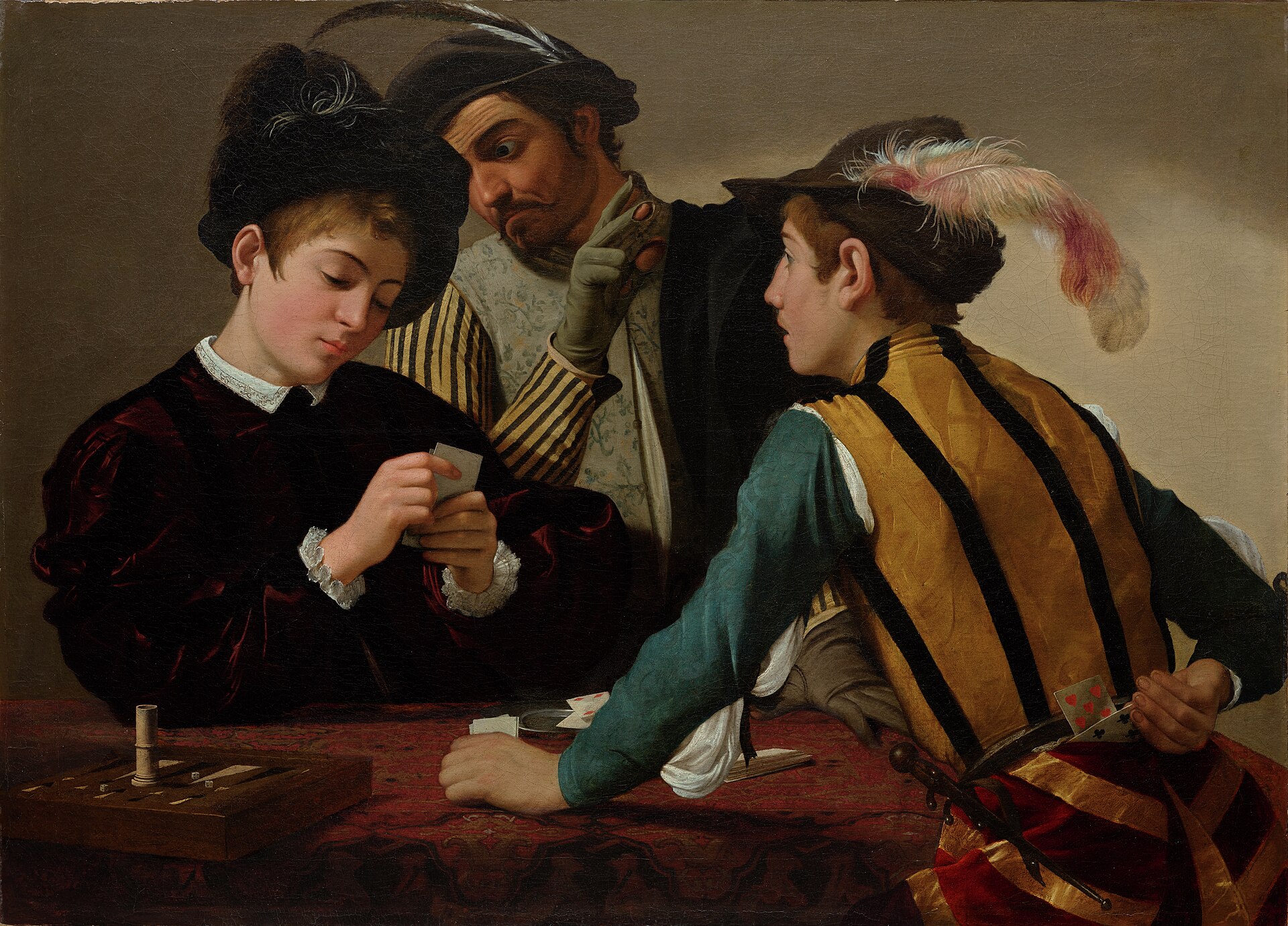
The forecast calls for rain, but it remains dry. Someone smiles cheerfully at you, while plotting your downfall. You’ve got a fever—but the only cure is more cowbell. Our Philosophical Happy Hour takes up the question of signs, obfuscation, obscurity, and the signs by which truth and falsity are known.
Nobody—or almost nobody—expects a career politician to be wholly truthful. Fewer and fewer people expect mainstream news to give honest reporting. CEOs of technology companies are becoming famous for breathlessly overhyping their products’ capabilities.
We are all quite familiar with falsity, that is. But not all falsities are the same: the duplicity of politicians is not the same, let us say, as when we misunderstand the meaning of an unfamiliar word. Nor is an artfully crafted media narrative the same as a misdiagnosed disease symptom. And profit-driven hype about artificial intelligence may make us feel like a storm is about to break, but such deception is not the same as when we see dark, heavy clouds roll overhead, and incorrectly surmise that rain is about to fall.
In each case, commonly, the truth is obscured. How does such obscurity happen? It seems to differ: sometimes it is by the intention of the utterer, sometimes by the thing itself, sometimes by our own interpretive failure—or perhaps, sometimes, by a combination of all or any of the three. To understand this phenomenon, I believe we can aid ourselves by considering signs.
What is a Sign?
This question—at the Lyceum, at least—is considered fundamental. We talk about signs often, but the discussion deserves frequent repetition, given how important signs are for our humanity.
In brief: a sign is not a thing, but a relation, and specifically a threefold relation, by which one thing serves to make cognitively present a second to a third. Or, less abstractly put: when I see a stop sign, that makes cognitively present the law, to stop my vehicle at that point, to me, the motorist. Or when I see smoke, I know there is a fire. Or when I hear a word, I know that there is a thought or an idea. Commonly, these three elements are called the sign-vehicle (that which bears the signification), the object (that which is signified), and the interpretant (that which receives the signification).
But not all signs are constituted in the same way.
Nature and Convention
Beginning with St. Augustine of Hippo (c.350–430ad), a distinction has commonly been made between natural (or “given”) and conventional (or “instituted”) signs. A natural sign is any being which bears within itself the capacity to signify its object. Smoke, for instance, because it is the effect of fire, is a natural sign. So too are footprints and storm clouds. Conventional signs, on the other hand, require either an act of will, resulting in what we call a stipulated sign; or a common and repeated behavior, resulting in what we call a customary sign.
As an example of a stipulated sign, I might say, “Wait for the count of ‘five’, then go!” That “five” signifies the time to go is a stipulation: there is no necessity linking that sign-vehicle to that object. By contrast, we can recognize as a customary sign some regular association of events not necessarily connected: say, if your neighbor daily closes his shade at sundown and raises it in the morning when he gets his coffee, you can interpret the raised shade as a sign of his having gotten his coffee. He has not stipulated that the raised shade signifies his coffee acquisition, but it signifies it nonetheless.
Obfuscations
Of course, we may see how conventional signs easily are used for deception. Every falsely-made promise uses a stipulated sign falsely: a sign is given for an object to which the utterer intends no fidelity. “I will pay you back as soon as I can”, the con-man says, while planning never to see you again.
But what of natural signs? We seem often to misinterpret their significance as well. Were it not the case, no disease would ever go misdiagnosed, and every weather forecast would be infallible.
What is most interesting, however, is the potential for overlap between the two kinds of signification. We human beings are natural creatures, and though we operate constantly within convention, we not only have natures ourselves, but those conventions are built atop such natures. Put otherwise, even the most sophisticated conventional construct requires a natural basis.
Signifying the Truth
All men, by nature, desire to know—so writes (in one common translation) Aristotle, in the opening of his Metaphysics. But do we desire to know the truth?
Put otherwise, we might be very comfortable with many deceptions; more comfortable with them than with the truth. Is that contrary to our nature? Moreover: should everyone know all things, at all times? Presumably not—we can all likely think of things in our own personal lives that we not only want kept secret, but which it is not good for certain others to know.
This Wednesday (09 September 2026, from 5:45-7:15+ pm ET) we will take up the theme of signification and falsehood, of truth and falsity, of revealing what is and obscuring it deliberately, through these and related questions:
- Can a natural sign be false, or is that only a fault of interpretation? Can the weather lie? Can non-human animals or plants?
- Are natural signs inherently more trustworthy than conventional signs?
- How does obscurity of the object come about? Is it from the object signified, the sign-vehicle, or the interpreter?
- Can conventional signs manipulate our interpretation of natural signs? Does distinguishing the two help us better understand the constitution of each?
- Does successful deception depend upon truthful signification? That is, do we need an environment in which signs commonly lead us to what truly is, in order that they be used to lead us away from the truth?
- Where is the boundary between natural obscurity and deliberate obfuscation? When does selective arrangement, withholding, or emphasizing certain signs become deception?
- Can deliberate deception ever be prudent or justified for the sake of the common good? Is there such a thing as a “noble lie”—or does political prudence require fidelity to truthful signification even when the truth is difficult, dangerous, or easily misunderstood?
Open to the public
Philosophical Happy Hour
Join a meaningful public conversation every Wednesday, 5:45–7:15 p.m. ET.

Leave a Reply