
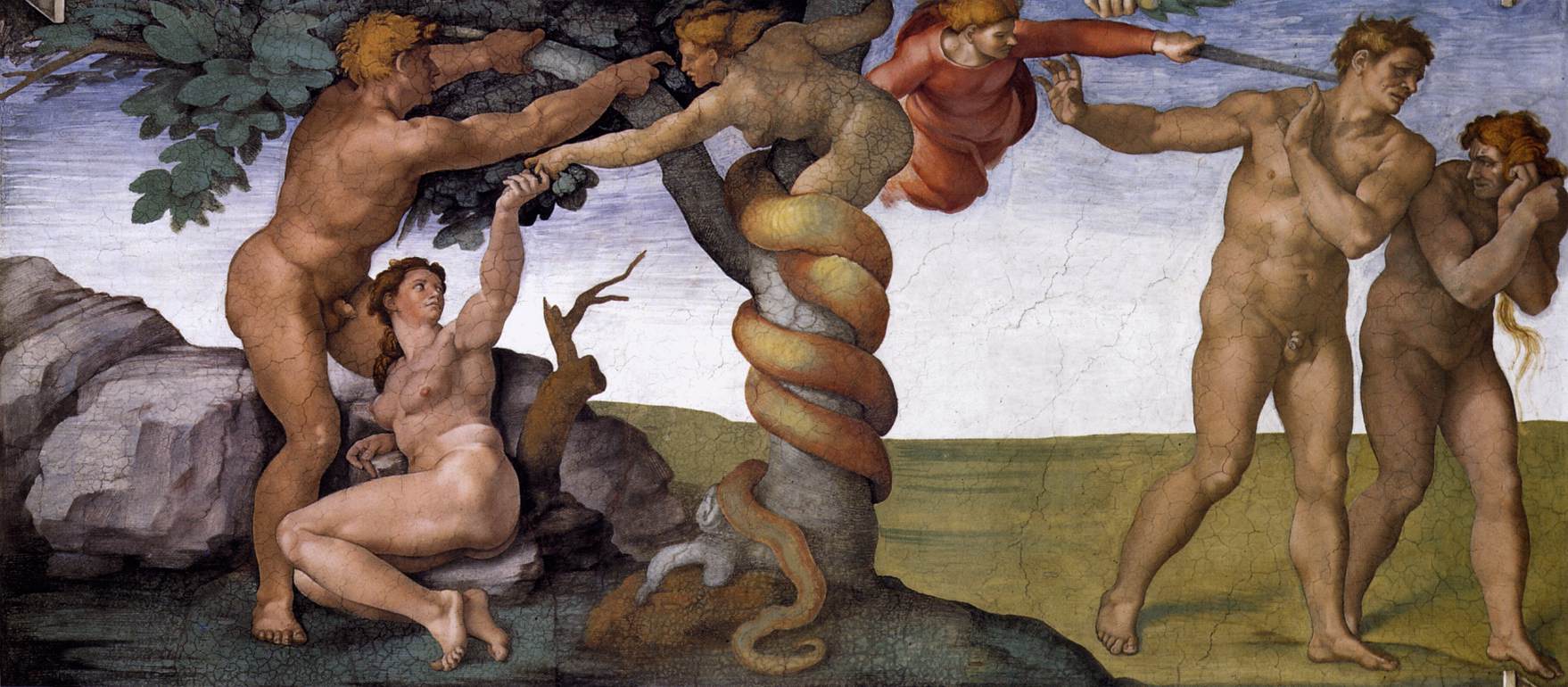
Who among us has not felt a cringe, a desire to disappear, when the eyes of another alight upon our faults and failures? Shame is a feeling equally powerful and undesirable. But what is it, itself, and what role does it play in our lives? We take up these questions in our Philosophical Happy Hour.
Extraordinary moments in our lives tend to create the strongest memories. A first kiss, first day on a big job, birth of a child, major successes in education or career and so on. But many of those moments may not be good or pleasant to remember. Walking in on someone naked (or being walked in on!), saying something really stupid in front of people you think are really smart, slipping down the stairs in a full assembly hall, being mocked in front of your friends—all things that have, in fact, happened to me, and that I remember with painful clarity.
As experiences go, they are each quite different from the others. For some of our shames there seems to be no blame to be had; and yet we feel there is nonetheless.
But just what is shame, and what role does it play in human life?
Shame: Gift or Curse?
An interesting early consideration of shame can be found in Plato’s Protagoras, at 322b-d. Here, the titular Protagoras, in answering a challenge from Socrates to explain how virtue can be taught, offers the following (Lamb translation, modified):
…as often as they were banded together they did wrong to one another through the lack of civic art, and thus they began to be scattered again and to perish. So Zeus, fearing that our race was in danger of utter destruction, sent Hermes to bring shame [translated by Lamb as “respect”, but using a word which may also be translated as shame; αἰδώς] and right among men, to the end that there should be regulation of cities and friendly ties to draw them together.
Then Hermes asked Zeus in what manner then was he to give men right and shame [αἰδώς]: “Am I to deal them out as the arts have been dealt? That dealing was done in such wise that one man possessing medical art is able to treat many ordinary men, and so with the other craftsmen. Am I to place among men right and shame in this way also, or deal them out to all?”
“To all”, replied Zeus; “let all have their share: for cities cannot be formed if only a few have a share of these as of other arts. And make thereto a law of my ordaining, that he who cannot partake of shame and right shall die the death as a public pest.”
We might wish, that is, never to feel shame; and yet here, according to Protagoras’ Zeus, there cannot be a city, a common civic entity, without shame. Why is this?
Virtue and Vicious Society
Another set of considerations (indeed, rather more extensive) can be found in the works of Aristotle. In particularly, let us look at his Nicomachean Ethics, Book IV, c.9 (Bartlett & Collins translation; see other translations here), 1128b 10–36, where he writes:
It is not fitting to speak about a sense of shame [αἰδώς] as a particular virtue, for it seems more like a passion than a characteristic. It is defined, at any rate, as a certain fear of disrepute, and it turns out to resemble the fear of terrible things, for those who feel shame blush and those who fear death turn pale. Both, then, appear in some way to be bodily, which seems to be more a mark of a passion than of a characteristic. But this passion is appropriate, not to every age but to the young; for we suppose that the young ought to be bashful because of the many errors they make, in living by passion, are checked by a sense of shame. And we praise those of the young who are bashful, but no one would praise an older man because he is given to shame: we suppose that he ought not to do anything that incurs shame. Shame does not belong to a decent person, either, since it occurs in connection with base things (for one must not do such things). And whether these are shameful truly or shameful according to opinion makes no difference, for neither is to be done; as a result, one should not feel shame.
And in his Rhetoric (Book II, c.6), Aristotle defines shame as “a certain pain and perturbation pertaining to those bad things (present or past or future) that appear to bring disrepute”, whereas shamelessness is “a certain slighting of and apathetic indifference to these same things.” Subsequently, he goes on to explain that we feel shame before the admirable or honorable, or when our shameful act is broadcast to many, and not only by doing ugly things, but by speaking about them, or being associated with signs of them. And quite interestingly—to me, at least—at 1384b 37-38 he writes that “they feel shame before their familiars when it comes to things that seem shameful and truly are such, whereas [they feel shame] before those at a greater remove from themselves when it comes to things that seem shameful according to convention.” (Barlett).
By identifying shame as a passion, associated with a “certain fear of disrepute”—or a “pain and perturbation pertaining to those bad things… that appear to bring disrepute”—even apart from the rest that he says—Aristotle gives us much to ponder. Does it come from the things themselves? The disrepute (always something from others)? Is it the fear or the pain?
Shame Within and Without
In his Summa theologiae, IIa-IIae, q.144, Thomas takes up the concept of shame at some length—drawing heavily upon these two texts of Aristotle. St. Thomas says much, and incorporates many subtle distinctions, particularly as pertains to perfection and what is praiseworthy. But I want to draw our attention to one passage in particular. We find it at a.2, ad.1 (Shapcote, slightly modified):
Shame properly regards disgrace as due to sin which is a voluntary defect. Hence the Philosopher says (Rhet. ii, 6) that a man is more ashamed of those things of which he is the cause. Now the virtuous man disdains the disgrace which he bears on account of virtue, because he does not deserve it; as the Philosopher says of the magnanimous (Ethic. iv, 3). Thus we find it said of the apostles (Acts 5:41) that they (the apostles) went from the presence of the council, rejoicing that they were accounted worthy to suffer reproach for the name of Jesus. It is owing to imperfection of virtue that a man is sometimes ashamed of the reproaches which he suffers on account of virtue, since the more virtuous a man is, the more he despises external things, whether good or evil. Wherefore it is written (Isa 51:7): Fear ye not the reproach of men.
Note well this passage: “the virtuous man disdains the disgrace which he bears on account of virtue, because he does not deserve it”—that is, he is impervious to the efforts at shame from “mere convention”. Does this contradict the end of the quote above from Aristotle’s Nicomachean Ethics?
Can Shame Be Restored to the Shameless?
Today we seem to have a rather shameless society—that is, a society in which there appears no “horror of the disgraceful”. It often seems to me that such shamelessness is itself, no less (and perhaps much more) than that of the virtuous man, impervious to reproach. Have we no hope but on the minds of younger generations? Can we redeem the shamefully shameless of older generations?
This Wednesday (23 September 2026, from 5:45-7:15+ pm ET) we will unashamedly shame those who are shameless (if we can)… or, at least, try to ask some good questions and think through what shame really means and why it might be important to the human experience. So, please join us as we ask these following questions, and others like them:
- Can we have a society without shame? Consider again the text of Plato’s Protagoras, quoted above.
- Is shame primarily fear of what others think, or recognition that something really is disgraceful?
- Can one be ashamed—legitimately or illegitimately—when one has in fact done nothing wrong? If so, does that reveal a defect in oneself, in society, or neither?
- Why does Aristotle deny that shame is a virtue while nevertheless regarding it as admirable, and why especially in the young?
- Does moral formation aim at producing proper shame—or eventually at making shame unnecessary? Or are these two somehow part of something one?
- Who has and ought to have the power to make us feel shame?
- Can a certain shamelessness sometimes be virtuous?
Open to the public
Philosophical Happy Hour
Join a meaningful public conversation every Wednesday, 5:45–7:15 p.m. ET.

Leave a Reply