
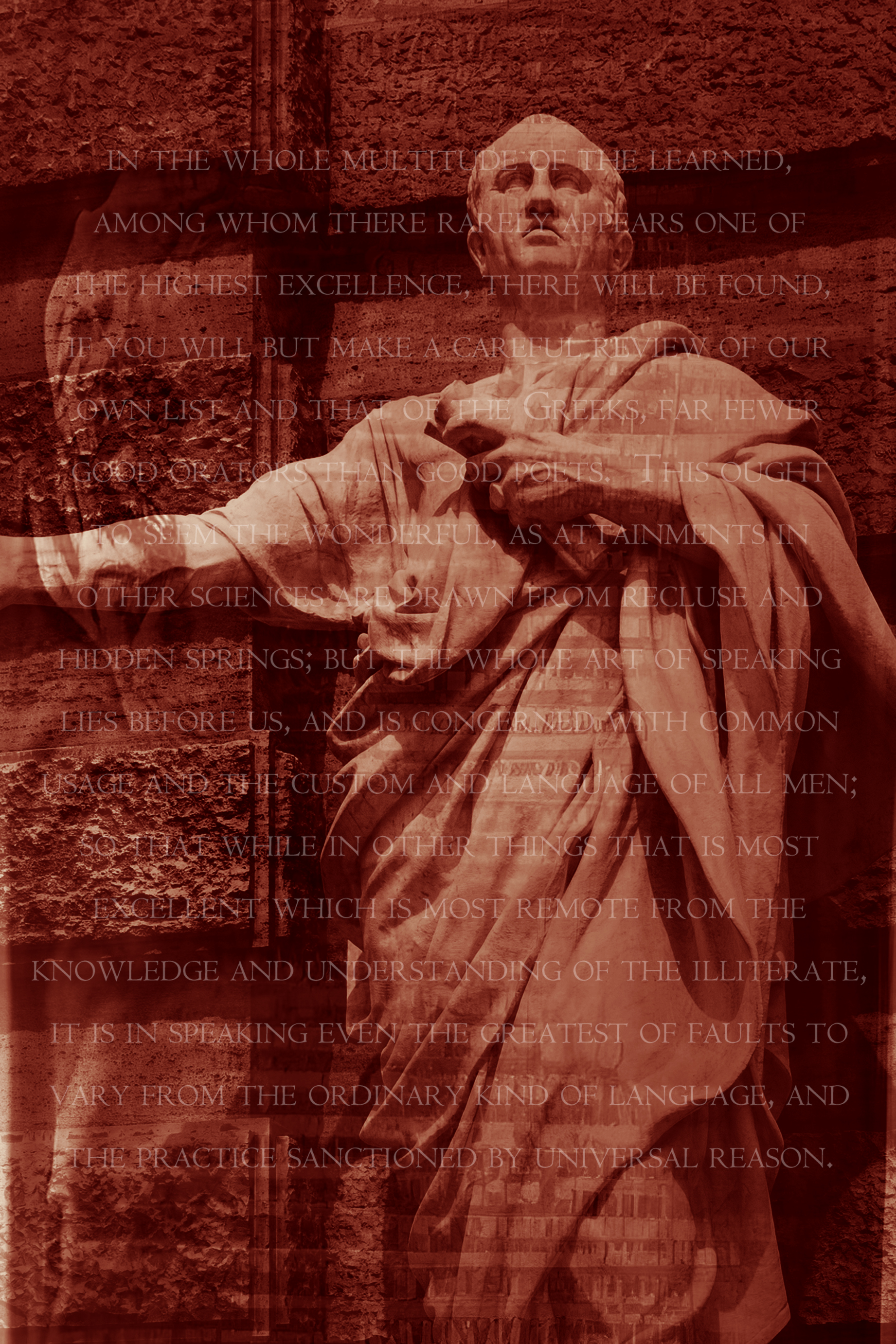
Art of Rhetoric I: Discovery of Arguments [2024]
“…it is strange if it is a shameful thing not to be able to come to one’s own aid with one’s body but not a shameful thing to do so by means of argument, which is to a greater degree a human being’s own than is the use of the body.” Aristotle, Art of Rhetoric, […]

The Standard of Truth
Often we have been told that the universe revealed to us by our eyes and ears, our taste and touch, gives a false presentation to the underlying reality: that, beneath the sensory lies a reality discerned through specialized instrumentation and intelligible only at the mathematical level. Sir Arthur Eddington quite famously proposed that there is […]
On Self-Education
As part of our program, members at the Lyceum Institute are encouraged to suggest rich topics for our weekly Philosophical Happy Hour. One member writes: What is the value of self-education? By this I mean education that one engages in, (either through books or courses) without the aid of a teacher. I think there is […]

A Philosophical Inquiry into Facts
What is a fact? The English word, used so commonly throughout the modern world, comes from its Latin cognate, factum: an event, occurrence, a deed, an achievement. But since the mid-17th century, under the auspices of the Enlightenment’s so-called “empiricism”, the word has been taken to be a “reality” known as independent of observation. The […]

On Education and Its Institutions
The contemporary controversy concerning education centers around the institutions tasked with providing it. We ask ourselves what curricula should be implemented, what teaching methods are most effective, and how governmental agencies can assist in the growth of educational institutions—we debate the morality of teachers and their influence, the rights to speech and questioning, the difficulty […]

Art of Rhetoric I: Discovery of Arguments
“…it is strange if it is a shameful thing not to be able to come to one’s own aid with one’s body but not a shameful thing to do so by means of argument, which is to a greater degree a human being’s own than is the use of the body.” Aristotle, Art of Rhetoric, […]
