
What Makes a Thinker Worth Exploring?
A Philosophical Happy Hour asking why (or whether) we should read some thinkers over others, explore some ideas before the rest, and take some philosophers more seriously than others. A question surfaces again and again in philosophical discussion, sometimes with impatience: why do certain thinkers keep returning? Why are Plato and Aristotle, Augustine and Aquinas, […]

Dr. Brian Kemple on “The Lame Shall Enter First”
Executive Director Brian Kemple joined Dcn. Harrison Garlick of Ascend: The Great Books Podcast to discuss a short story of Flannery O’Connor, “The Lame Shall Enter First”. You can find (and follow) Ascend on X.com here, and listen to their podcasts on all these many platforms—or watch on YouTube below.
Greek: Plato’s Apology [Winter 2026]
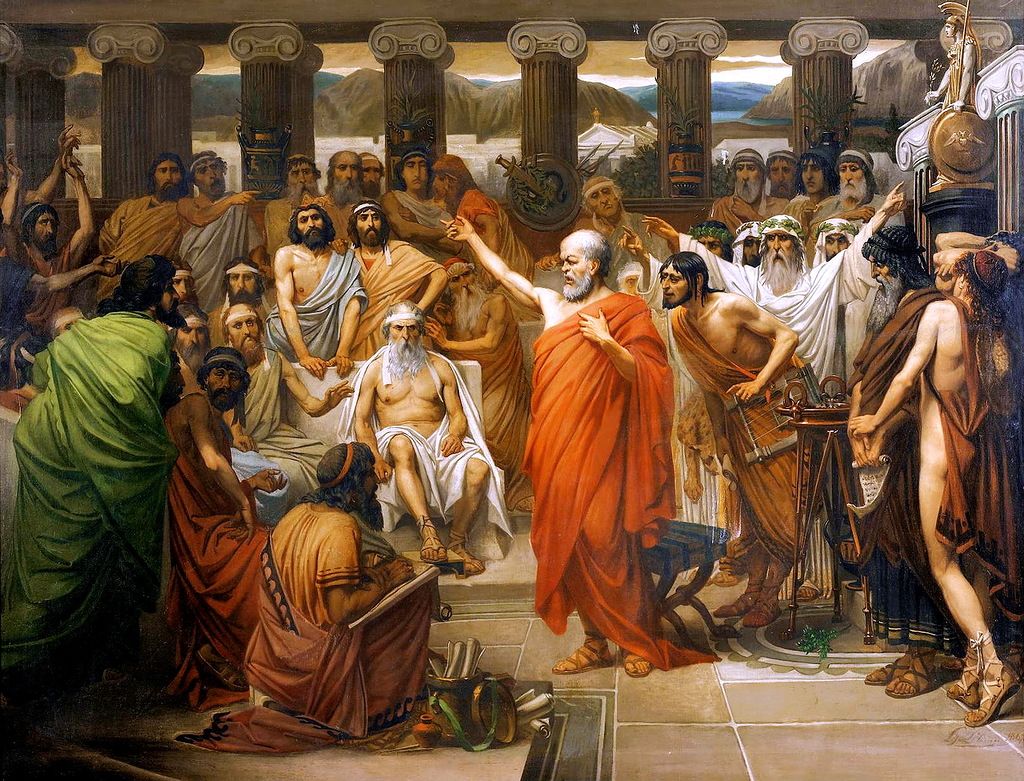
Announcement of our Winter 2026 Greek Course, reading Plato’s Apology—can we discover the depths of Plato’s thinking in the original language? Description Details This course includes eight weekly readings, lectures, and live class sessions. The class sessions are recorded but must be attended. All required texts will be provided in PDF format. Public pricing from […]

Catharsis and the Intellectual Life
In this conversation, Brian Kemple is joined by Daniel Wagner, a Faculty Fellow of the Lyceum Institute, in exploring the motivations behind intellectual pursuits, the significance of classical education, and the contrast between modern and classical educational philosophies. 00:00 – Introduction to Intellectual Pursuits 03:01 – Catharsis, Healing, and Philosophy 06:55 – Understanding Classical Education […]

On Christianity and the Interpretation of Philosophy
A Philosophical Happy Hour on the influences of Christian belief on philosophical interpretation, and of philosophical wisdom on the practice of the Christian faith. Is there such a thing as “Christian philosophy”? Today, thinking of antiquity draws new interest. The texts of Plato and Aristotle, Plotinus and Porphyry—even the fragments of Parmenides and Heraclitus, the […]

Winter 2024: Introduction to Philosophical Thinking
We hear the word “philosophy” used often—often in cringe-inducing ways (“My philosophy on this is…” “That’s an interesting philosophy…” “His coaching philosophy…”), where the speaker really means an opinion or a method. For others of us, it might conjure up images of books or a college course catalog; perhaps something having to do with symbolic […]

Musings on Extrinsic Formal Causality and Practical Signs
This is not quite how I envisioned this first blog post turning out… Originally, I had considered writing something on the issue of the political common good, focusing on the plurality of common goods in relation to the political exercise of social justice in its original and true sense (namely, the right ordering of various […]

IO2S Deely – Augustine: Instituting the Given Sign
The Latin Age of philosophy was one of the most productive, systematic, and insightful times of intellectual inquiry in human history—despite the oft-given reductive and willfully-ignorant treatment that labels all between the fall of Rome and the rise of the Renaissance as the “Dark Ages”—for which the first major figure was Augustine of Hippo. Most […]

Winter Seminars – Reminder
Still time to sign up for 2022 Winter Seminars! Discussions start soon, readings already posted.
[2022 Winter] Introduction to Philosophical Thinking
What is philosophy? Is it something we study—as subject, like biology or literature? Is it something each of us has, individually—as in, “my personal philosophy”? Is it a relic of history? An intellectual curiosity? A means to impress at cocktail parties and on social media? Or perhaps—as this seminar will attempt to demonstrate—philosophy is a […]
