
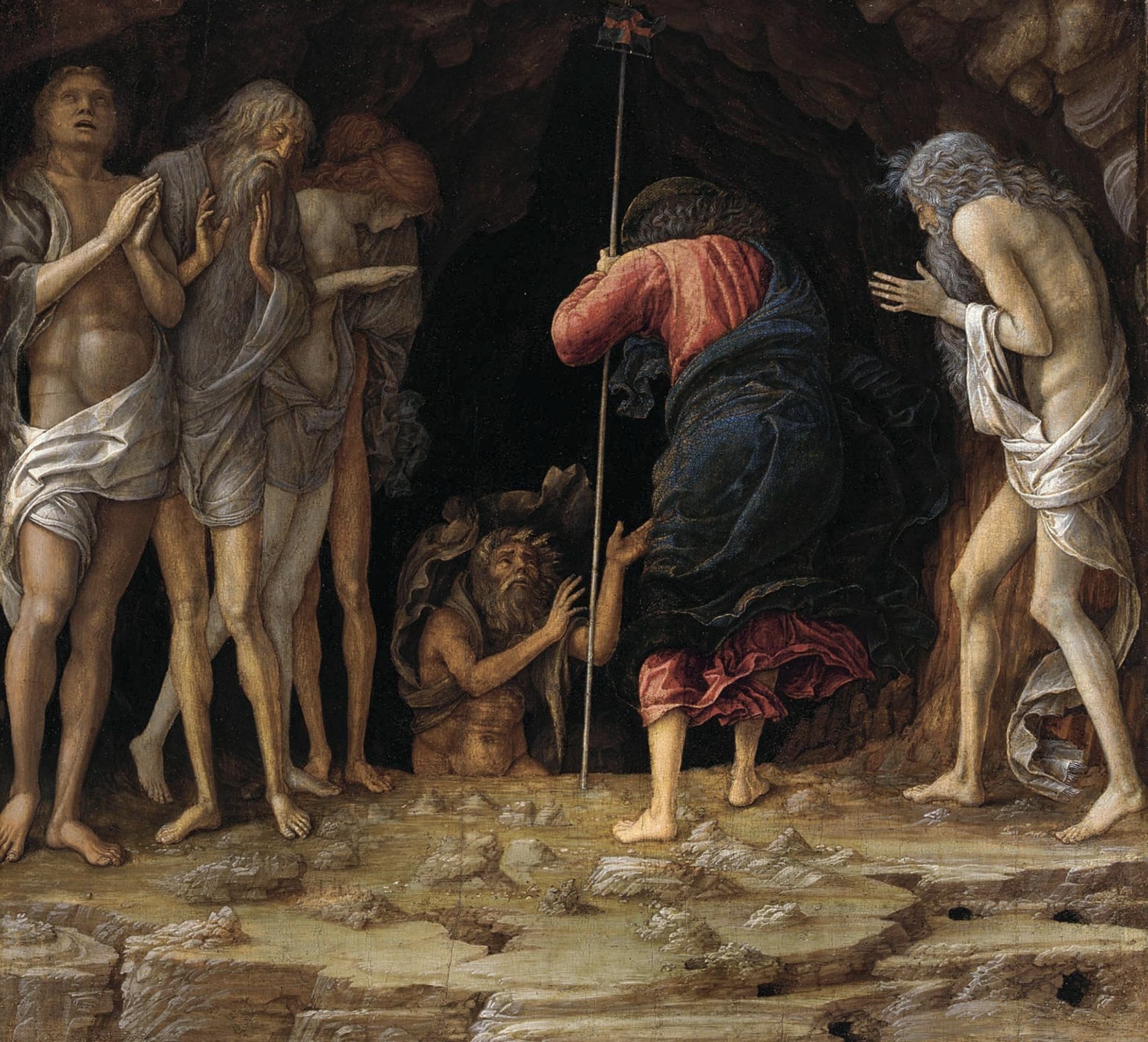
An essay on avoidance of thought about the significance of death.
By now, even without knowing much about him, I suspect that most people have likely heard of Bryan Johnson, the men employing the most extreme and elaborate (and expensive) anti-aging protocol in recorded history. Johnson believes that, through the use of medicine, scientific understanding, and technological advance, we will be able to control the development of the human body—ultimately to the point of “neutralizing aging” and effectively eliminating corporeal decay and physical demise. “Natural causes” (Johnson and others believe) will no longer be listed as a cause of death.
Questions abound concerning Johnson’s authenticity. His website—blueprint.com—has links to the countless supplements and dietary products he uses through Amazon affiliate links, for which he receives a commission. The site also sells its own brand of Olive Oil, with the dubious and unverified claim that it is healthier than what one would typically buy in the store. Johnson’s fortune was made in technology (best known for Braintree, which is further best known for acquiring Venmo, before the joint entity was acquired by PayPal for $800 million). We are, for good reason, suspicious of tech moguls reared in the bosom of capitalism. Are they ever not finding a way to profit from our desires?
More importantly, however, questions also abound concerning Johnson’s motivations. These may be more relatable and universal.
The Fear of Death
On New Years’ Day of 2025, Netflix released a documentary about Johnson, Don’t Die: The Man Who Wants to Live Forever. One sees the algorithmic decision-making which guides nearly every second of Johnson’s day: his routines for skincare, haircare, exercise, diet, supplementation, sleep, and so on.
Highly-stylized and likely duplicitous in more than one way, the film nevertheless pulls back the veil—at least somewhat—on the thinking behind this quest for eternal life. One could get lost in the weeds of at-a-distance psychoanalysis: the effects of being raised in the Mormon church, working in tech and being an entrepreneur, divorce (both his parents’ and his own), paternal absenteeism, etc. But what most captured my attention in watching the documentary were two statements Johnson made, close together: “I have found more relief in demoting my mind and elevating my body than I have in my entire life” and “I have always been desperate to be free from myself.”
Later on the documentary, Johnson claims not to fear death but to love life. Of course, this “but” can only pretend to be adversative: the fear of loss follows the love of anything. But we suffer death not only in the loss of our corporeal life. We suffer also a death of the spirit, the elan vital, through which life becomes more than merely a series of motions.
Concomitant with this spiritual life we discover ourselves to bear a responsibility: the responsibility of being a self. To live as Johnson does, it seems to me, strives to—through a fear of spiritual death—avoid the responsibility of being a self.
Significance of Second-Hand Experience
I was quite young when I had my first personal encounter with death. My oldest brother died in a car crash. He was 19, I was 5. Seven years later, the only grandparent I had known passed away. In another ten years, my father followed, by lung cancer. A year and a half later, a close friend drowned—when I was close enough to hear, but not to help.
But even the most painful, gut-wrenching death of another—even if one witnesses countless deaths in close proximity, the deaths of friend and loved ones—do not inform us fully of our own deaths. In fact, we strenuously avoid even thinking of our own deaths, especially as our own. I think here of this passage from Martin Heidegger’s Being and Time:
One says, “Death certainly comes, but not right away”. With this ‘but…’, one denies that death is certain. ‘Not right away’ is not a purely negative assertion, but a way in which one interprets itself. With this interpretation, one refers itself to that which is proximally accessible [to the human in his unique way of existing]… and amenable to its concern… Thus, one covers up what is peculiar in death’s certainty—that it is possible at any moment. Along with the certainty of death goes the indefiniteness of its “when”.
Put otherwise, we push the thought of death away from ourselves. We export that thought into extrinsic systems by which we outsource the question. Many do this with their religious belief. Others, with medical science and treatment. That is: “I know I will go to heaven (or elsewhere) when I die.” Or, “When I die, the doctors will take care of it.” Now we see the pivot, increasingly, to posthuman technology: “When I die, my consciousness will be uploaded” or “I will simply not die, but live forever.”
This latter move pushes the question even farther away from truly being thought.
Of course, nothing and no one else can truly handle our dying for us. We experience something of death, and truly—if naught but its absolute finality (though almost certainly more)—in the passing of a loved one. Yet this experience of the other’s death is not the same kind of thing as even thinking about one’s own demise. And death remains always possible at any moment.
Despair and Fear
My God, My God, why has Thou forsaken Me? (Matthew 27:46).
Faced with the immanent inevitability of His own death, Christ cries out to His Father—an anguished cry, a cry of abandonment. It might, to our weak ears, sound like the cry of despair. Not only does Christ express abandonment, indeed, but an unknowing, an ignorance of why. Who among us does not know that pain—the pain of not knowing, not knowing why? But the cry signifies something more than this pain with which we resonate; it is a sign, oddly enough of hope. The Venerable Fulton J. Sheen writes, in commentary upon these words:
Christ’s cry was of abandonment which He felt standing in a sinner’s place, but it was not of despair. The soul that despairs never cries to God. As the keenest pangs of hunger are felt not by the dying man who is completely exhausted but by the man battling for his life with the last ounce of strength, so abandonment was felt not only by the ungodly and unholy but by the most holy of men, the Lord on the Cross. The greatest mental agony in the world, an the cause of many psychic disorders, is that minds and souls and hearts are without God. Such emptiness would never have a consolation, if He had not felt all of this as His own. From this point on, no atheist could ever say in his loneliness, he does not know what it is to be without God! This emptiness of humanity through sin, though He felt it as His own, was nevertheless spoken with a loud voice to indicate not despair, but rather hope that the sun would rise again and scatter the darkness.
We face today a time of great darkness. Many—anguished but silent—suffer a despair at the possibility not only of living well, but, indeed, of simply being human. What could be more terrifying, to someone who despairs of being human, than the responsibility for dying well?
Significance of the Good Death
We desire the everlasting, and by nature. This in itself should strike us as odd. Why this desire? What, in our experience of the world, would suggest something that can go on unendingly? Everything we see, all that we touch, undergoes dissolution. Even all the stars and planets, we now believe with very strong evidence, have a finite time to exist.
Yet we hope to live forever, somehow. Is this self-deception? Or a true resonance deep within our souls? To love a good is to fear a loss; but to love a good demands also that we know that good as it is in itself, and not merely as we would wish it to be (cf. Augustine c.395, Confessions, IV.6-12). It is good that we hope for eternal life. It is not good to hope for this life to be eternal; for such is not the nature of this life, and we lose the good when we pursue it through falsities.
Instead: we must learn to die well—and await the sun to rise.
No responses yet