
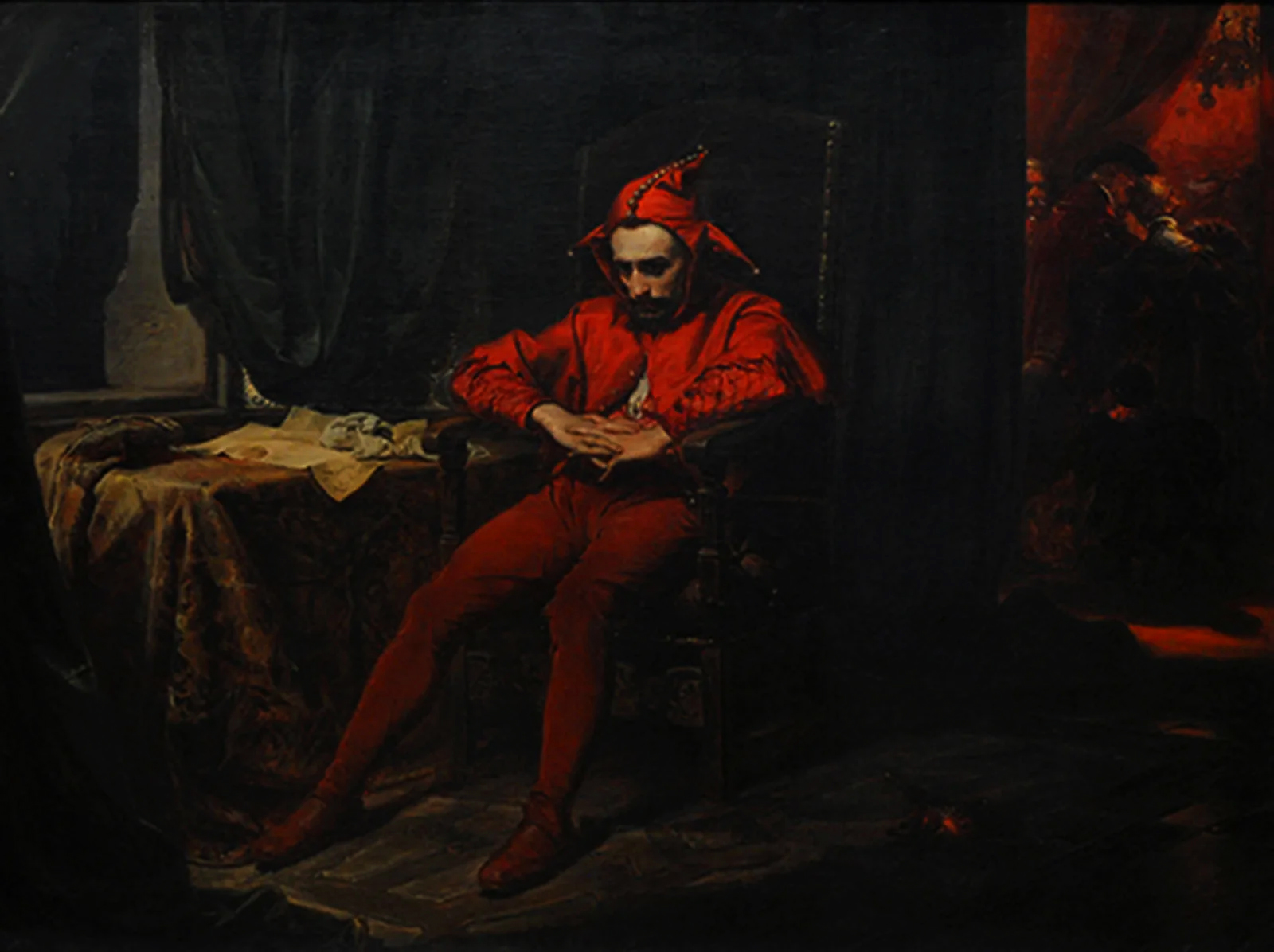
To complement our recent Happy Hour discussion of tragedy, let’s consider the concept of comedy.
The Nature and Praxis of Comedy
As permits our time and—above all—my supply of shamefully light beer, we shall discuss at our next Happy Hour the nature of comedy and the comedic.[1] To facilitate our chat, I propose we undertake the following:
- First, to define or at least demarcate comedy (this surely involves distinguishing the concept of comedy from [inter]related but distinct concepts such as humor and laughter;
- Second, to explore comedy from several intellectual disciplines (chief to my mind are the literary[2], the philosophical, the scientific, and the theological) as well as one’s own aesthetic taste (personal, societal, cultural, etc.); and
- Third, and most importantly, to roast justly the executive director of the Lyceum, Dr. Brian Kemple, for his slander of Pabst Blue Ribbon and jazz, his general “cromulence,” his Peccata Clamantia, and more. (For guests and newcomers: know we like jokes ‘round these parts!)
Overview and Guidance
To guide our gab, I offer the following:
First, two linked historical overviews. Above all, I encourage folks to read John Morreall’s helpful overview of the philosophy of humor. So too: for those of a more literary persuasion, Cyrus Henry Roy’s overview is surely suitable. (Feel free to bring along your own readings and rants as well.)
Second—and to my mind, more fruitful—are some questions for reflection, grouped roughly with reference to the tasks stated above. Perhaps we can ponder the following before our chat:
- How to define comedy? Can it be defined? How does it differ from concepts such as laughter?
- Has our definition of comedy expanded over time (i.e., is it now broader than its Greek beginnings?)
- Does any specific intellectual perspective (e.g., the literary or the philosophical) best elucidate the comedic? Despite their different emphases and disagreements, can these disciplines work together to provide a satisfactory understanding of comedy?
- Regarding personal taste, what do you tend to find humorous or unhumorous? Are there any topics you find specifically suitable or unsuitable for comedy? If so, why?
- Perhaps most fundamentally: why does comedy exist, and what does its presence teach us about reality?
Have a Laugh
Please join us this Wednesday (25 September 2024) for our Philosophical Happy Hour (5:45–7:15pm ET; latecomers welcome!) as we strive to better understand comedy. (Anyone who manages to avoid reference to C.S. Peirce or semiotics during the chat earns one free lemonade, paid for in full by the Executive Director Director of Languages.)
philosophical happy hour
« »
Come join us for drinks (adult or otherwise) and a meaningful conversation. Open to the public! Held every Wednesday from 5:45–7:15pm ET.

[1] I’ll likely use these terms interchangeably but, to tease one of Kierkegaard’s emphases: are “comedy” and the “comedic” identical, or can we distinguish them?
[2] I am using “literary” to refer loosely to the broader tradition of artistic production and art criticism within Western civilization. I have in mind the gamut of our comedic works, from ancient plays to modern YouTube clips and Tweets. So too with the other disciplines: science as “natural” or “social”, theological as “revealed” or otherwise.
No responses yet