

“From Rational to Semiotic Animal”
An extract from Deely 2006: “Semiotics, History of” in Encyclopedia of Language and Linguistics, Second Edition (London: Elsevier) v.11: 216–29. The thinkers of the Latin Age, inspired by Aristotle, liked to distinguish between remote and proximate potentialities. Thus, awareness or knowledge of the action of signs was no more than a remote possibility the long […]

2024 Summer: Aristotle’s Physics
Join us on an intellectually rigorous journey through Aristotle’s conception of physics as a scientific discipline in our upcoming Lyceum Institute Seminar. Why study the physics of an ancient thinker? One might think (and many do) Aristotle’s scientific work obsolesced by the discoveries of modernity. In truth, while he may have been mistaken in particular […]

Evolution: Science, Religion, and the Truth
Questions concerning the nature of evolution—questions which find their way into discourse time and again—have cropped up yet again. This post will make an effort to outline some of these issues, with view to fostering a fruitful discussion for our Philosophical Happy Hour (24 April 2024) on how we ought to think of evolution. It […]

On the Execution of Philosophy
The most well-known exemplar of the philosophical attitude, Socrates, was put to death for his habits of questioning. On different occasions, Socrates described himself as a “midwife”—assisting his interlocutors through the difficult and painful process of giving birth to thought—and as a “gadfly” (an annoying, biting insect, difficult to shoo away). This latter attribute, in […]

Science & Engineering
Ask most people today what we mean by “science” and the answers will vary, but commonly include that it is: empirical, experimental, authoritative, highly specialized, the result of intensive training, and concerned with discoveries that are precise, accurate, and actionable. One also finds the word frequently paired with “technology”—as well as “engineering” and “mathematics” (STEM). […]

Winter 2024: Introduction to Philosophical Thinking
We hear the word “philosophy” used often—often in cringe-inducing ways (“My philosophy on this is…” “That’s an interesting philosophy…” “His coaching philosophy…”), where the speaker really means an opinion or a method. For others of us, it might conjure up images of books or a college course catalog; perhaps something having to do with symbolic […]

Living through the Barbarism
Perhaps this is an odd title—Living through the Barbarism—but it seems that ours is an age of unthinking strife. As a Lyceum Member asks: What is work and what is its purpose? This is something I have been thinking about a lot recently but also as a follow up to our conversation on Private Property […]
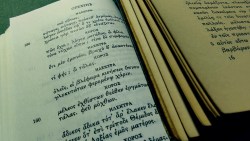
Announcing: Greek 2024
Aeschylus and Aristophanes, Plato and Aristotle, Xenophon and Thucydides: it is one thing to know their texts. It is another to read them in the language their authors used. The roots of Western culture sprung up in Ancient Greece. If we are to be successful cultivators of future growth ourselves, we ought to attend to […]

Dr. Daniel Wagner on the Human Good
Our Faculty Fellow and Associate Professor, Director of Catholic Studies, and Chair of Philosophy as Aquinas College in Grand Rapids, MI, was on the Acton Line podcast of the Acton Institute last year (but just let us know recently!). Give a listen here: Reason, nature, and the human good – YouTube

Art of Rhetoric I: Discovery of Arguments
“…it is strange if it is a shameful thing not to be able to come to one’s own aid with one’s body but not a shameful thing to do so by means of argument, which is to a greater degree a human being’s own than is the use of the body.” Aristotle, Art of Rhetoric, […]
