
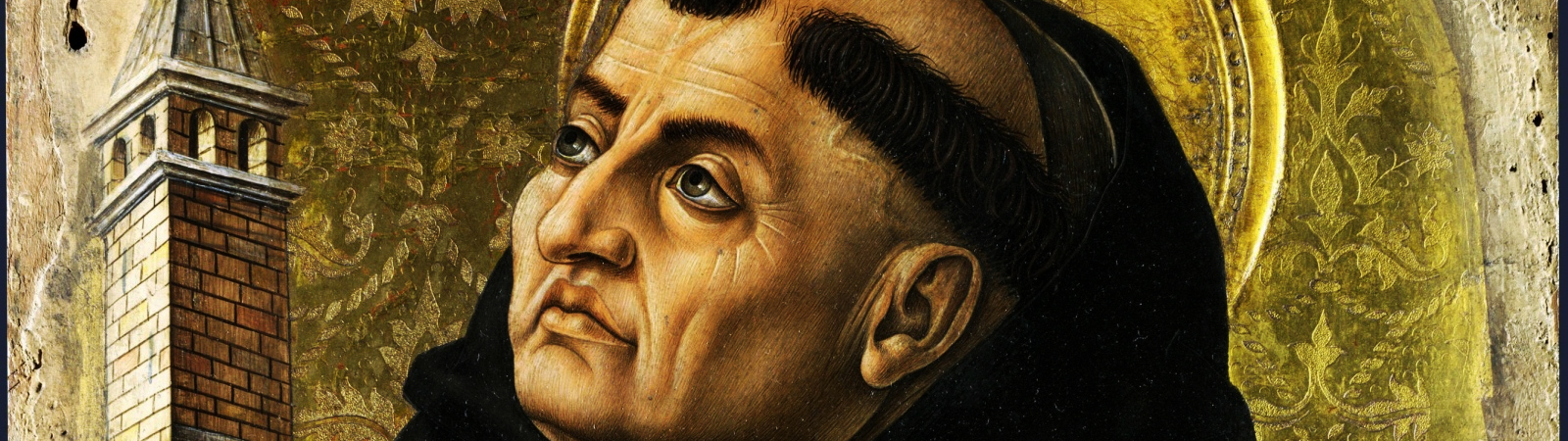
Does Thomism have a Future?
A Philosophical Happy Hour on the Past, Present, and Future of Thomism and its philosophy: must it change? Can it? Is it “relevant”? Not including the works of St. Thomas himself, nor of his Latin Age commentators and followers, I have four full shelves of books that one might consider “Thomistic”. These books, written as […]

Meet the Columbanus Fellows: Bea Cuasay
Today we introduce another of our Columbanus Fellows—who are demonstrating their commitment and desire to grow in knowledge, wisdom, and understanding through a creative retrieval of the classic Western tradition and participation in genuine dialogical inquiry. Bea Cuasay is an alumna of Saint Mary’s College in Notre Dame. She received a B.A. in Philosophy with […]
Meet the Columbanus Fellows: Joshua Streeter
Today we continue highlighting some of our Columbanus Fellows, demonstrating the quality of our endeavors! These fellows are engaged in a rigorous and deep inquiry into the Western intellectual tradition, seeking both to retrieve lost wisdom and to further its presence in our society today. Joshua A. Streeter is a doctoral candidate in the Department of […]
Meet the Columbanus Fellows: Lance Gracy
Over the next several months we will highlight a few of our Columbanus Fellows, bringing to light the character of students engaged in our program! These fellows are engaged in a rigorous and deep inquiry into the Western intellectual tradition, seeking both to retrieve lost wisdom and to further its presence in our society today. Lance […]

Complete Lyceum Catalog – 2024
We have completed our 2024 catalog and preliminary schedule for all seminars and courses! While these are, of course, always subject to change (life being ever-unpredictable), I am happy to announce this very exciting slate of philosophy seminars for the upcoming year: Seminar Catalog 2024 Winter (Q1) Introduction to Philosophical Thinking – Brian Kemple Phenomenology: […]
Catherine Project: Spring 2024 Offerings
Our friends over at the Catherine Project have opened their submissions for Spring 2024 tutorial, reading group, and language tutorials! Their wide range of offerings cover many fascinating works and ideas: Plato, Aristotle, Aquinas, political theory, novels, the work of Wendell Barry, Latin, Greek, the art of writing, and more. You can discover their catalog here […]
Announcing: Latin 2024
We are delighted to announce our Latin courses available in 2024. But… why Latin? Does the study of Latin—a language spoken by no people, no country, no nation today—offer us anything other than an affectation or the satisfaction of niche reading (or liturgical) interests? Do we gain anything from this language itself, or does it […]
A Brief Life of St. Columban
“The missionary labours of the Irish were not confined to Great Britain, but extended far and wide through the west of Europe. In the sixth and seventh centuries, Irish monasteries were founded in Austrasia and Burgundy, Italy, Switzerland, Bavaria; they were established among Frisians, Saxons, Alemanni. And as centres of Latin education as well as […]

Introduction to Scholastic Latin
Tuis ergo obsequiis, lector, si quis veritatis, non novitatis amator occurreris, haec quaecumque sunt, offerimus tuoque iudicio mancipamus, certi, quod si quid boni repereris, non nostrum esse, facile poteris apprehendere. Vale. John Poinsot, Cursus Philosophicus – “Lectori”, Quarta Pars Philosophiae Naturalis The study of Scholastic Latin—by which specifically we mean the Latin which emerged from […]

Guide to Enrollment
If you have ever wanted to know more about the different levels of enrollment at the Lyceum Institute, this short video provides some explanation!
