

Reimagining Politics: Seminar on the Proposal for a Postliberal Order
What comes after liberalism? In some sense for centuries, and most definitely for the past several decades, Western politics have been shaped by a largely presupposed consensus towards liberalism—an ideology founded upon individual autonomy, procedural neutrality, and technocratic governance. But today, cracks are widening in presumed foundation. Whether in the erosion of public trust, the […]
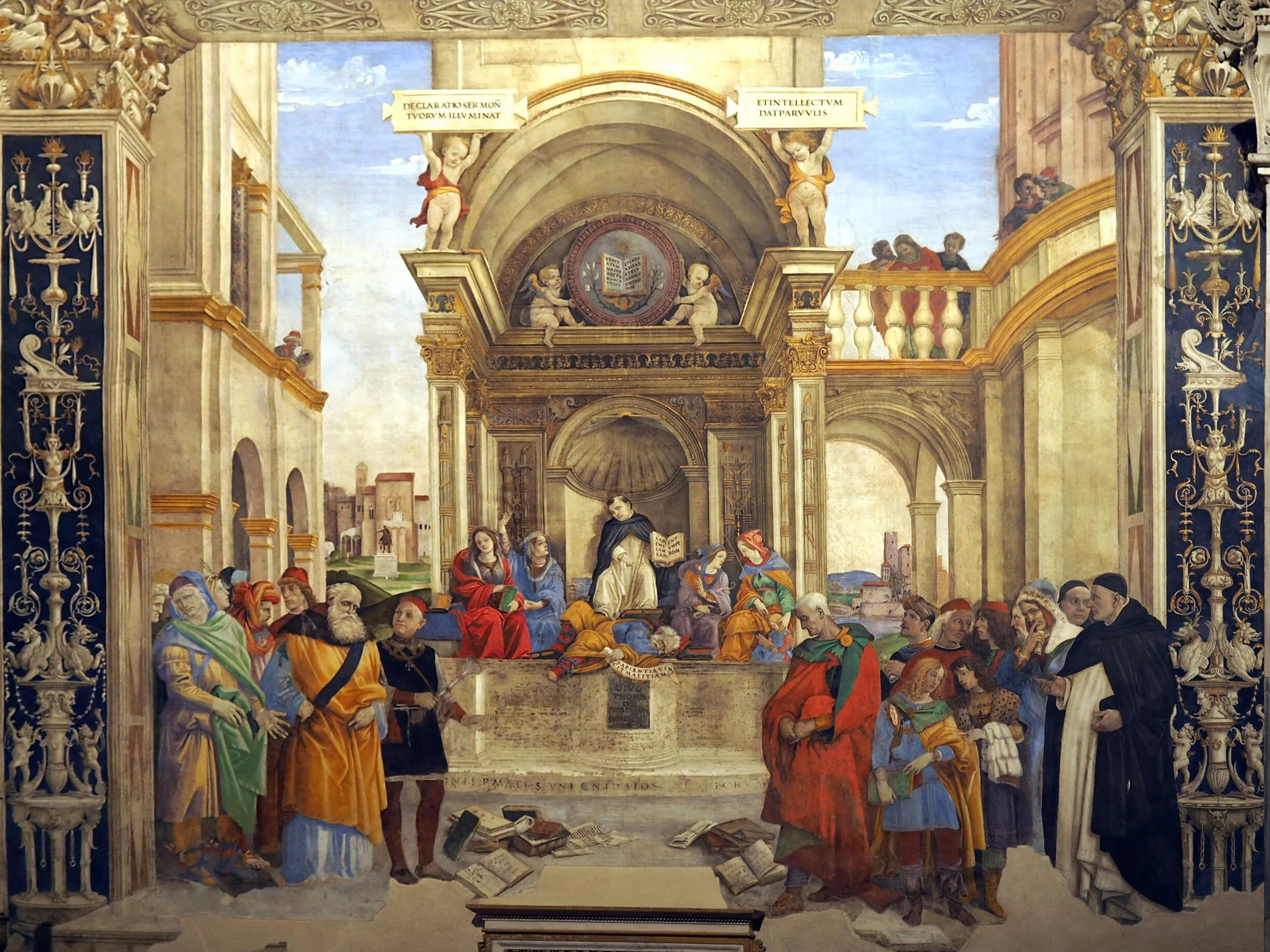
On the Relation of Reason to Faith
In this Philosophical Happy Hour we will turn our attention to the ever-persistent question of the relation between faith and reason. How should we understand the relationship between faith and reason? We will explore this question through the sharp and illuminating lens of St. Thomas Aquinas in his commentary on Boethius’ De Trinitate, specifically question […]

On Authentic Play
A Philosophical Happy Hour investigating the nature, significance, and importance of authentic play. What does it mean to play? Though we are all acquainted with play from an early age, we might be hard-pressed nonetheless to define it. On the one hand, it seems something common to higher animals: not only our pets—dogs and cats—but […]

On the Postmodern, Postliberal, and Postacademic
A Philosophical Happy Hour on the meaning of the postliberal, the postmodern, and the postacademic—and what we signify by “post-”. We do not think often enough about the meanings of words, especially those that have entered into the popular lexicon. The term ‘postmodern’ provides a good example of this unthinking, and in two ways. First […]

On the Experience of Evil in Our Souls
A Philosophical Happy Hour on the question: do we (some of us, all of us) need to experience evil—even sin, that experience of our own moral fault—in order to discover and know the good? Drawing upon some of the works of the great tradition, a member asks the question: “to what extent is it important […]

Spring Seminars [2025 Q2]
Announcing enrollment for our two Spring Seminars: Culture: More than Aesthetics and Thomistic Psychology: The Life of Thought. Culture: More than Aesthetics Thinking of art, we tend to think of the beautiful—and rightly so, for this, in some way, is to what all art aspires: if not directly, then indirectly, inasmuch as even the simple […]
Interview: On Being as First Known
St. Thomas Aquinas presents in the corpus of his work (at, e.g., De veritate q.1, a.1, Summa Theologiae Ia-IIae, q.94, a.2, and In Metaphysicorum, lib.4, lec.3, n.605) the claim that what the intellect first conceives is being and that the intellect further resolves all conceptions into being. Illud autem quod primo intellectus concipit quasi notissimum, […]

On Habits of Interpretation
A Philosophical Happy Hour on Obstinate Views and the Discovery of Meaning Does it feel sometimes as though the reality you inhabit is not shared with others? A recent Benedictine College commencement speech deemed controversial may well illustrate the point: some saw in these comments (particularly those beginning at 11:49) a demand that women “get […]

Living through the Barbarism
Perhaps this is an odd title—Living through the Barbarism—but it seems that ours is an age of unthinking strife. As a Lyceum Member asks: What is work and what is its purpose? This is something I have been thinking about a lot recently but also as a follow up to our conversation on Private Property […]

On Worldviews and Ideologies
Understanding the World(view) What do we mean by the common term “worldview”? Our English word originates from the German Weltanschauung (from Welt, meaning “world”, and Anschauung, “view”, “perception”, or even “perspective”). Often, the term is used as though it needs no explanation: “That’s your worldview”, “My worldview is…”, “The Roman worldview” or “The Catholic worldview”, […]
