
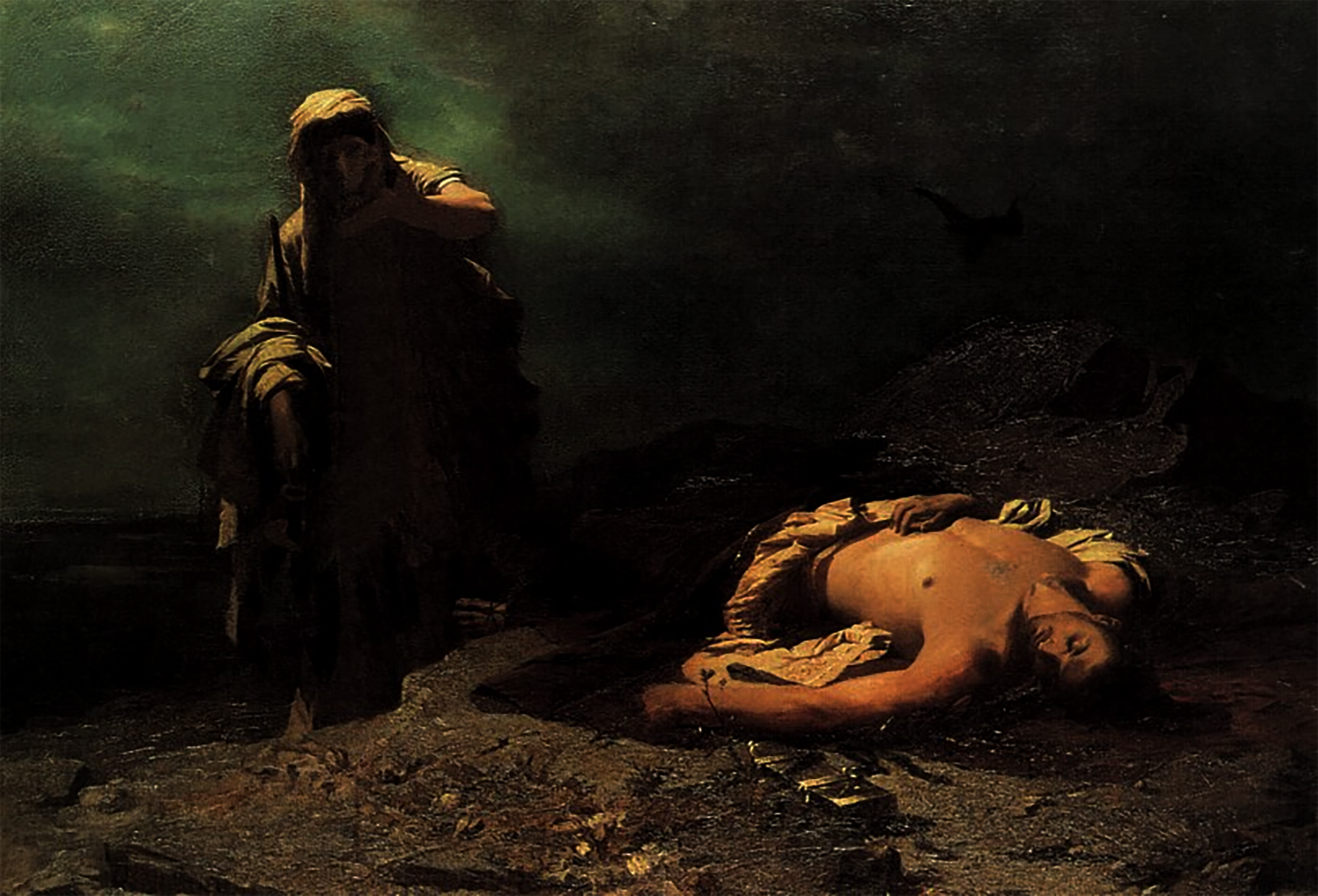
A Philosophical Happy Hour on the nature and purpose of tragedy in both poetic and real experience.
Twenty-three years ago, on nearly this day, many of us bore witness to an undoubtedly tragic event—a relative few with our own eyes, most through the television. I do not need to elaborate: only to say that I do not believe anyone who watched the towers collapse could truly comprehend what it was they were witnessing at that moment. We bore witness to televised murder—at the time, we did not know how many, but we knew the buildings were not empty. That carried heavy consequences, I think, not fully realized at the time. We did not see their deaths directly; but we saw the cause.
This magnitude—the greatness, the sense of its overwhelming quality, a quality that strains or even exceeds our present cathectic sensibility—seems ever-present in the tragic, whether it concern the loss of thousands of lives or a private matter of only a few individuals.
Historically, the term “tragedy” has been used for not only these real-life events, however, but also a certain common structure of poetic creation or story-telling. We are, on the whole I suspect, more deeply impacted by such stories than we are by comedies, romances, epics, or any other forms. The etymological root of the word is the verb, tragein, meaning to gnaw. This seems indeed to be what the tragic does; to gnaw at us, to worry our bones; a slow grind.
Poetic Tragedy
But what is poetic tragedy? By this term we indicate, in our modern context, a myriad of media: movies, novels, short-stories, television shows, plays, and, yes, poetry in the sense of rhythmic metered speech, as well. Aristotle, in his Poetics (a work incomplete in extant texts, and in which tragedy was considered only with respect to the play), defines it thus:[1]
Tragedy, then, is an imitation of an action of serious stature and complete, having magnitude, in language made pleasing in distinct forms in its separate parts, imitating people acting and not using narration, accomplishing by means of pity and fear the cleansing [katharsis] of these states of feeling.
This definition contains many parts, all of which we will not here analyze. Let us focus on three phrases, to see what questions they raise:
First: “an imitation of action of serious stature and complete, having magnitude”. Why an imitation? There is an obvious answer—that the tragedy is not real. But there is also a less obvious answer: what does it mean to imitate, truly? And what does Aristotle mean by “action of serious stature and complete”? We have already touched upon the importance of magnitude. But “serious stature and complete”—do we know what he means by these?
Second: “imitating people acting and not using narration”. Why acting and not using narration? How does this translate across media? If a novel includes narration, is it impossible for it to be tragic? What differentiates these two forms of conveying a story? Why does it say that it is people acting? Is it a tragedy if something awful happens naturally, or only if it is humanly-caused?
Third: “accomplishing by means of pity and fear the cleansing of these states of feeling.” Pity and fear. These passions are common to us all, but easily misunderstood. Aristotle defines them in his Rhetoric. Of pity he writes that it is “a certain pain at what is manifestly bad, and destructive or painful, and befalls someone who does not deserve it, which one might expect to suffer”.[2] Fear he describes as “a certain pain and perturbation arising from an imagining of an impending ill that is destructive or painful.”[3] How can this passion affect a cleansing—katharsis?[4] What is cleansed?
We should all reflect on the poetic tragedies we have observed through whatever media: both what they convey to us and how.
Real Tragedy
Conversely, while tragedy in poetic creation may illumine our experiences, it does not convey the same reality as experiencing something tragic oneself—of undergoing the tragic. Here, the gnawing grinds deeper; past the bones, to the heart itself. To lose a loved one; to witness others lose their beloveds; to see great potential wasted in reckless pursuits or moral profligacy—not only in a story, but in lives belonging or bound to our own souls.
I recall giving a presentation in my senior year of college, in a literature course, on a question of literary genre. I asked, and denied, that there could be such a thing as a truly Christian tragedy, in the Shakespearean sense of the term—a story ending with the death or downfall of a great man. The greatness of the Christian man, I argued, is indomitable; his death brings him into eternal life. If his downfall is moral, he no longer deserves the title of “a great Christian man”. It is a thesis with which I have silently wrestled for fifteen years. Having myself endured more years in this vale of tears, I am less sure now of my conclusions than I was then.
Certainly, the world viewed under the hope of eternal life appears far less tragic. Any finite suffering cannot compare to an infinitude of perfect happiness. But living in this finite and temporal world, as we do, we as the audience of real tragedy do find those events continuing to gnaw at us, even as we hope for final blessed resolution.
Perhaps, that is, something of pity continues to echo in this life—less from the departed and more from our own gnashing of teeth. But simultaneously, if we have experience by which we believe the good of eternal life is attainable, we have hope—and thus the evil which we fear, the “impending ill that is destructive or painful”, recedes.
Happy Faults
Does suffering the tragic, that is, mean something different for the believer than the non-believer? If we may have, through infinite mercy and justice, a life eternal, does this promise a good which may never be gnawed away?
Please join us this Wednesday (11 September 2024) for our Philosophical Happy Hour (5:45–7:15pm ET; latecomers welcome!) as we strive to better grasp tragedy in both its creative poetic structure and its experienced reality.
philosophical happy hour
« »
Come join us for drinks (adult or otherwise) and a meaningful conversation. Open to the public! Held every Wednesday from 5:45–7:15pm ET.

[1] Aristotle c.335BC: Poetics (Sachs translation), 1449b 25-28.
[2] Aristotle c.350BC: Rhetoric (Bartlett translation), 1385b 15.
[3] Ibid, 1382a 22.
[4] Cf. c.350BC: Politics, 1342a 5–16.
2 Responses
This is a graceful topic for this day. I lived in CT in 2011 after living in NYC for 18 years…I knew one person killed, one who escaped but has been traumatized, and one whose wife was an acquaintance. I went to the beach that a morning and watched the smoke pouring from the site. For a few brief days mourning brought people together—then it seemed as if we set our feet on a path of disunity, which has been so painful.
I mean 2001.