
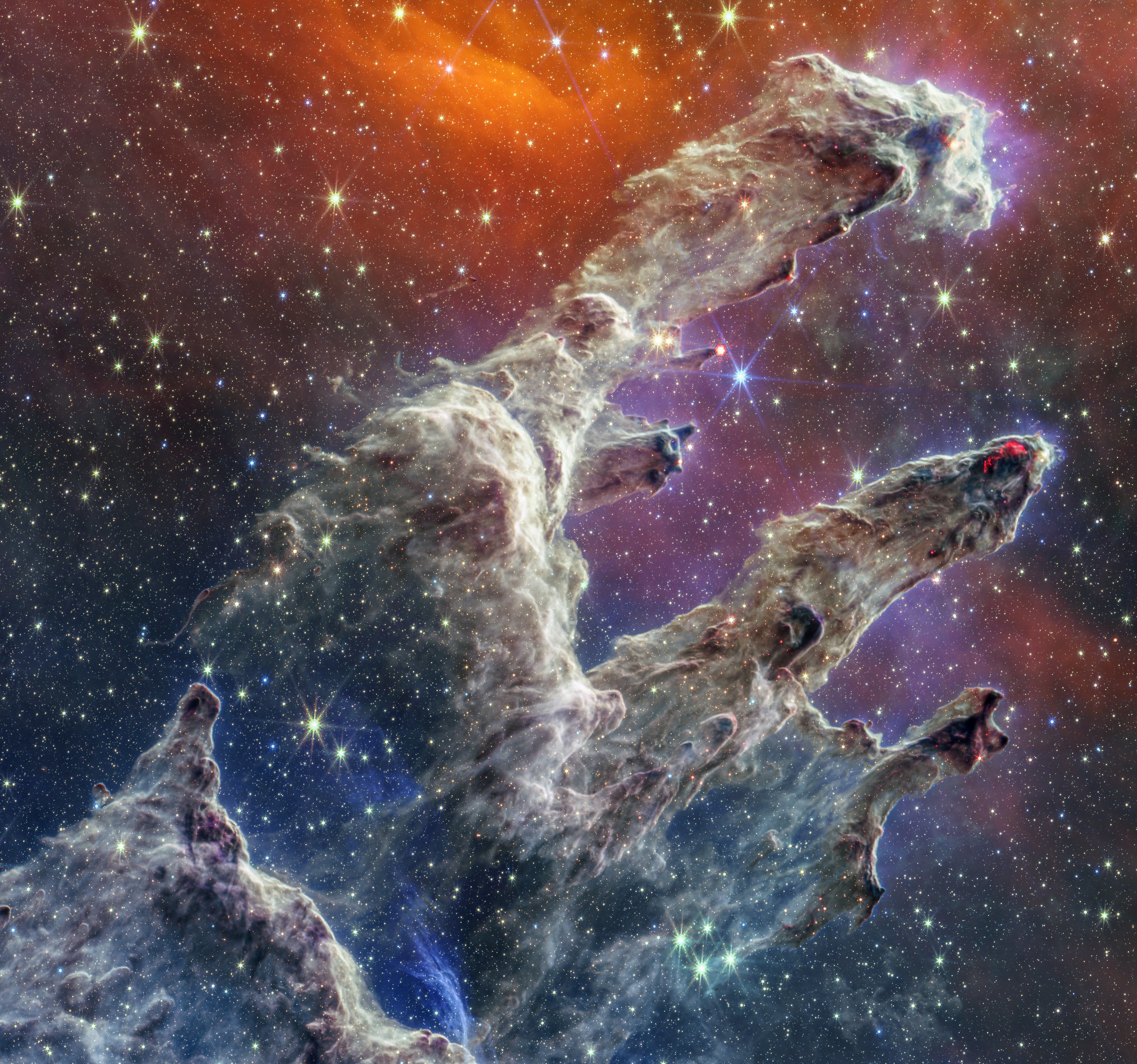
A Philosophical Happy Hour on the struggle against nihilism—cosmological and psychological—and inadequate methods to assure ourselves of meaning in the cosmos.
What is meaning? What do we mean when we say the word? What does the word signify? It is one of those funny words that everyone seemingly believes himself to know and yet which very few can define to even their own satisfaction. And yet, meaning seems to be something we all desire. We want our lives to be meaningful. A person will go to great lengths to find meaning in his or her life—sometimes, ruinously. Why is it such a struggle?
Meaningless Cosmos
Among the principal causes of our struggle and frequent failure to find meaning is the belief—often implicit—that, outside of human agency, the universe is meaningless. To be sure, those with a belief in God may hold that everything serves a greater purpose. They may look into the night sky (if they can see anything through the light pollution) and, beholding the grandeur of creation, marvel at its beauty. But are this wonder and this sense of purpose enough? That is: are these beliefs held “subjectively” in contrast to “objective, scientific fact”? Do these beliefs fall into a kind of dualism: spiritually good and purposive but physically neutral and meaningless?
Put otherwise, how can we contend with the facts? One can view the earth as the center of the universe, or even the solar system, only from a relativistic perspective. In terms of cosmic size, the earth is incredibly small—dwarfed by Jupiter, itself dwarfed by the Sun, itself dwarfed by other stars. In terms of best estimates as to cosmic time, humanity is but a blip: recently come into being and seemingly destined to disappear before too long.
Meaningless Life
These facts—viewed in this manner—seem to support the presupposition that meaning is indeed only the product of human agency. But does this cosmological nihilism entail a psychological nihilism? Can we, in fact, produce meaning where meaning does not pre-exist us? Some think so. But what are the consequences of man-made meaning? Does this not, in essence, make us “gods” of a kind? What happens to humanity when each person becomes free to create the meaning of life?
On the one hand, we see the potential (today often actualized) for anarchy in our world. On the other, we see an intolerable burden for all but the most narrow of minds; we are very finite beings and the cosmos is very large—most of it must be discarded as meaningless indeed, if we are burdened with the creation of all meaning.
Consequently, many might look for solutions to the crisis of cosmological meaning. Do we throw ourselves into dualism or mysticism or Gnosticism? Do we trust in an intuition that, because things feel as though they have a meaning of their own, they must? Or do such efforts fall short, do they obscure the reality in which we live?
Discovering Meaning
Recently, I wrote a brief essay on the question of cosmic significance. In this essay, I both critique the inadequate responses to our apparent insignificance and provide suggestions as to how we might, through recovery of a better philosophical vision, reclaim an understanding of the cosmos. This vision requires neither ignoring the corporeal structure of reality nor a flight into fantasy.
Join us this Wednesday (4 June 2025 from 5:45–7:15+ PM ET) to discuss competing images and visions of the cosmos, the role of philosophy for interpreting the meaning of our lives, and the reclamation of hope. Download the essay in PDF here.
philosophical happy hour
« »
Come join us for drinks (adult or otherwise) and a meaningful conversation. Open to the public! Held every Wednesday from 5:45–7:15pm ET.

No responses yet