
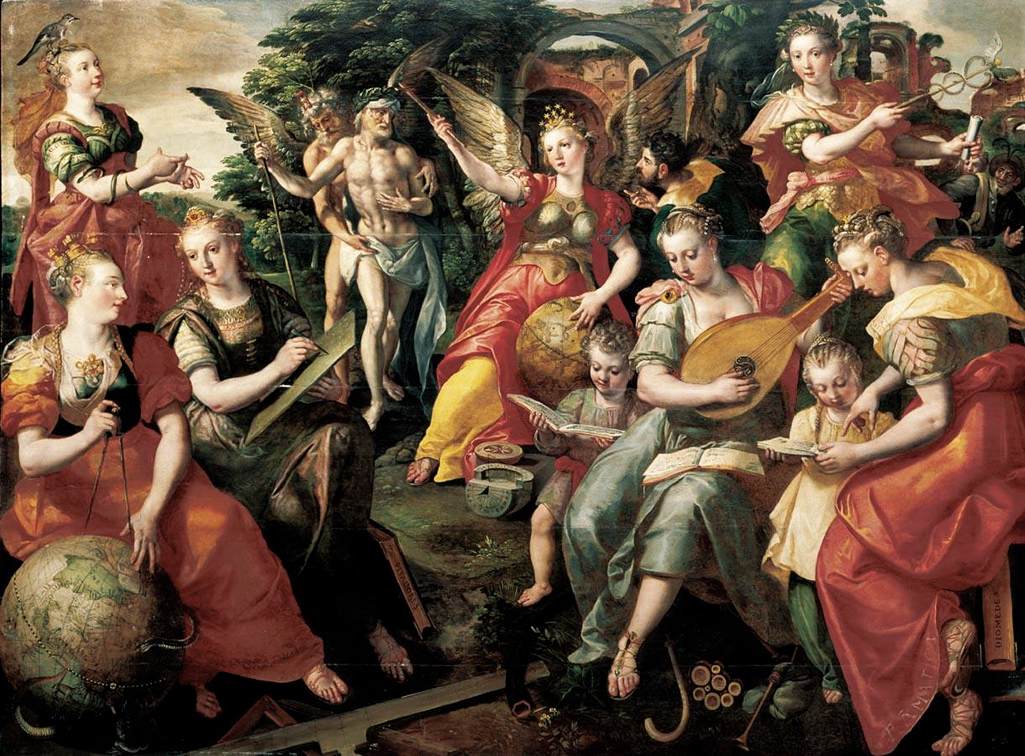
A Philosophical Happy Hour concerning the present conditions, future prospects, and most promising directions for the pursuit of higher education
Every reality which exists only in the concrete, corporeal world—and especially those that exist only or primarily within the socially-constructed realities of human interaction—has a natural lifespan. They are born, they mature, and, eventually, they die. Yet often, just as with our loved ones, we cling to their existence. We desire, contrary to their natures, that they should possess an earthly immortality. But the nature of the material world is to change—every form that has existence in matter must observe that matter’s decay, a dissolution of the act by which that matter exists at all. Death remains the end for all things.
So it is that we must ask, in 2025, whether the current formal institutions of the academy have outlived their natural lives. That is: do we prolong the academy today by unnatural, extraordinary means—keeping the organs functioning but without a soul by which it may live in fact?
Do we perhaps, if we are honest with ourselves, cling to the preservation of our current paradigms simply because we do not know where else to turn? As Fr. James V. Schall wrote, “where does one go when the university and cultural system fail to be good guides and become instead sources of confusion and hindrances to truth?”
Purpose of Higher Education
Much has been written on the life of the mind that deserves great attention and consideration—Sertillanges, Pieper, and Hitz all being valuable contributors to our heritage—but among the most foundational texts is John Henry Newman’s Idea of a University. These words, originally given in lectures of 1852, indicate the essential purpose of any institution of higher education. We need add little to what Newman writes:
This I conceive to be the advantage of a seat of universal learning, considered as a place of education. An assemblage of learned men, zealous for their own science, and rivals of each other, are brought, by familiar intercourse and for the sake of intellectual peace to adjust together the claims and relations of their respective subjects of investigation. They learn to respect, to consult, to aid each other. Thus is created a pure and clear atmosphere of thought, which the student also breathes, though in his own case he only pursues a few sciences out of the multitude. He profits by an intellectual tradition, which is independent of particular teachers, which guides him in his choice of subjects, and duly interprets for him those which he chooses. He apprehends the great outlines of knowledge, the principles on which it rests, the scale of its parts, its lights and its shades, its great points and its little, as he otherwise cannot apprehend them. Hence it is that his education is called “Liberal.” A habit of mind is formed which lasts through life, of which the attributes are, freedom, equitableness, calmness, moderation, and wisdom; or what in a former Discourse I have ventured to call a philosophical habit.
This philosophical habit, this liberal habit of mind through which the educated gains not only knowledge but through its study certain faculties of reasoning and self-control—certainly this should produce a society of human flourishing. Not a society, mind you, without contention; but one in which the struggles and disagreements are rendered fruitful by a persistent and common spirit of seeking the truth. But we must ask: can the university still today provide this?
State of Lostness
Broadly speaking, the ideal purpose of higher education evidently suffers today in two distinct ways. The first is what I shall call the “material ailment”; the second, “formal decay”. The material ailment stems principally from demographic and financial failings. Demographically, it is recognize that enrollment will be falling off a cliff, starting in 2025—a sharp decline in the birthrate starting around 2008 signals a decrease of incoming freshman of at least 15%. Combining this birthrate decline with a lowering perceived value of a college degree (and indeed, a growing nihilism among the youth altogether) results in a much steeper decline being likely.
Closely related to this degrading perceived value is the increased cost. Since the early 1990s, college tuition has outpaced inflation by 200-300%. Correlatively, an increase in the use of loans extends the financial burden of students now often well into middle-age. The inability to earn a substantial income during the four-plus years of earning a Bachelor’s—or more, if one goes on for graduate studies—impedes the ability to cultivate savings or begin earning passive income through investment.
More serious, however, is the formal decay—that is, the loss of vital form by which the university, by which higher education, has been animated in the previous two centuries. It belongs to a more elaborate argument than can here be provided, so allow me here simply to assert that the material ailments are not a mere temporary disease, but a rather signs of this formal decay.
The university can no longer sustain the life of the mind. We will discuss why in our Happy Hour—but we may also draw here upon these few pages of John Henry Newman’s Idea of a University, in which he discusses (even as far back as 1852) a great failing in the institutions of education; then, but a temporary illness, and now, grown into a terminal cancer.
Future Prospects and Promises
I do not think this death of the academy entails interment of the intellectual life, however. We may yet preserve and even enlarge the philosophical habit, bereft though we are of institutions today adequate to the task. It falls to us, that is, to gather together in pursuit of wisdom, to share our love of the truth, to seek new forms for traditions of genuine learning.
So join us this Wednesday (23 July 2025, from 5:45-7:15+ pm ET) to nourish the future prospects of an intellectual life.
philosophical happy hour
« »
Come join us for drinks (adult or otherwise) and a meaningful conversation. Open to the public! Held every Wednesday from 5:45–7:15pm ET.

No responses yet