
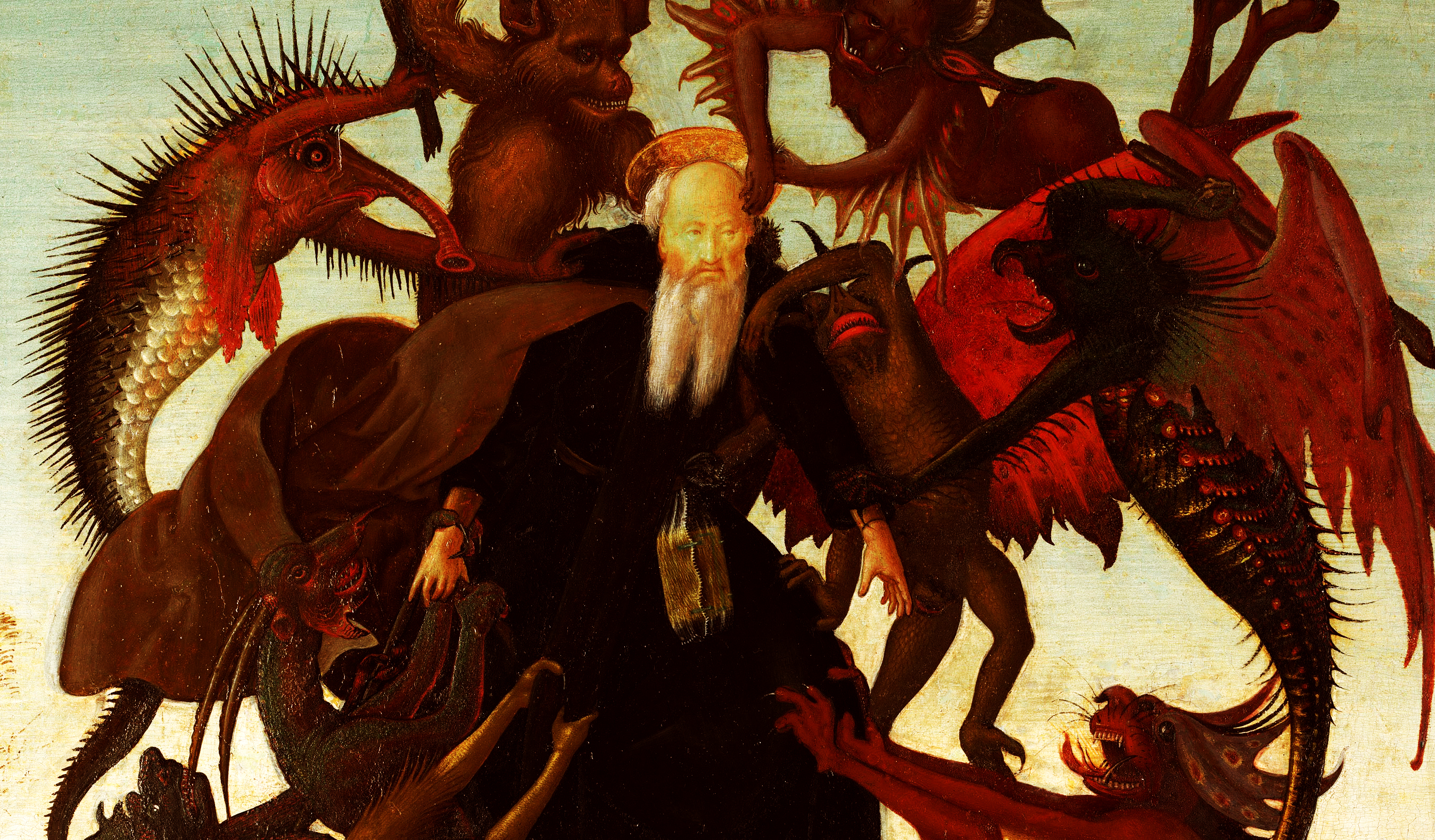
A Philosophical Happy Hour on the ways in which passion may capture and distort our exercise of reason—or, in proper subordination, affect a coherence of our persons
Thinking clearly. It seems a vanishingly rare virtue. Ours is a reactionary time. Reaction, however, seldom comes from the clear light of reason—but rather from the murky vapors of passion. But what is passion? Today, many interpret this term “romantically”: as though it signifies a spontaneous overflow of powerful feeling, an internally-generated movement of the self toward the other. This notion itself, however, seems the product of unclear thought.
The etymology of the word “passion” tells a different story. Our English word derives from the Latin verb patior, pati, passus sum (so too our words “patient” and “patience”), meaning “to suffer”. This suffering includes but need not be something that causes pain. More fundamentally, it signifies that the one “suffering” undergoes some change from an exterior agent. Such a change can either be contrary to or consonant with one’s nature; but most properly, the term signifies an action that derives the recipient of something proper to its own being.
Thus, while our passions may be good in some sense—dependent beings that we are—they must always be in the proper relation to reason; they must not interfere with the clarity of our thinking. Yet today, passions are given free reign to cloud our minds.
Reason, Captive of the Passions?
Rather infamously, the Scottish philosopher David Hume (1711–1776) claims in his Treatise of Human Nature (the second book of which is dedicated to the passions) that, “Reason is, and ought only to be the slave of the passions, and can never pretend to any other office than to service and obey them.”[1] For Hume, the passion was an “original existence”—not bound to a representative quality, but only inclining towards some end; the end desired being itself outside the scope of reason. Many people implicitly believe this and accordingly set their reason to subservient machinations on behalf of passion’s satiation. Many a cunning mind forsakes prudence on behalf instead of “satisfying” lust or avarice for money or power.
More than a century prior, the English poet John Donne—himself somewhat infamous for the erotic tenor of his poems—expressed the captivity of his reason to passion in a multitude of poems. “The Flea”, “The Ecstasy”, and many of his “Elegies” use powerful erotic metaphors and language. But in his later works, especially his Holy Sonnets, he retains this imagery for more spiritual and pious purposes. Consider the lines of his Holy Sonnet XIV:
Batter my heart, three-personed God; for, you
As yet but knock, breathe, shine, and seek to mend;
That I may rise, and stand, o’er throw me, and bend
Your force, to break, blow, burn and make me new.
I, like an usurped town, to another due,
Labor to admit you, but oh, to no end,
Reason your viceroy in me, me should defend,
But is captive, and proves weak or untrue.
Yet dearly I love you, and would be loved fain,
But am betrothed unto your enemy:
Divorce me, untie, or break that knot again,
Take me to you, imprison me, for I
Except you enthrall me, never shall be free,
Nor ever chaste, except you ravish me.
Is it so bad, then, for reason to be captive to passion, if passion’s object of love is the highest, the greatest? Put otherwise, if passion belongs to us by nature, then is it not natural for us to suffer movements caused by the highest goods? Should these not overwhelm our reason? We desire love not merely of a cold and calculated arrangement of convenience or compatibility, but to be moved by the beloved—Dante no less than Donne.
Passion, Reaction to Reason?
Sticking with the theme of love as a passion most powerful, we see St. Thomas Aquinas—whose Treatise on the Passions spans q.22–48 of the Summa theologiae, prima secundae—add helpful clarifications to our understanding of the passions. For he asserts the passions, contrasted with the reason, belong to what is lesser in the human soul. Thus, to be ordered by the passions is to be ordered improperly.
Simultaneously, however, the right ordering of the passion is a certain perfection (see, e.g., I-IIae, q.26, a.1-2, q.27, a.1, q.28, a.5). How does the passion attain a right ordering? By the judgments of reason, and especially of those belonging to the person possessing prudence. But—is it not the case that passion, by its very nature, disturbs the clarity of thought; that it disrupts the clarity of prudence? That it drags the intellect from its task of universal apprehension and bends it to particular bodily concerns of the here and now?
This is the danger of passion in a time of unruled appetites: not that it moves us, but that it inverts the order of our lives. Reason, lacking discipline, is made into a sophist and seducer on behalf of disordered desire. And yet—can we truly understand what constitutes the good for us as human beings if we do not understand ourselves as impassioned creatures? We love and hate, fear and hope, lapse into acedia and sorrow and despair; are moved to excitement and curiosity. We suffer pain and experience delight. Are these to be understood as mere automatic responses to corporeal stimuli—or an integral part of our cognitive lives?
Liberating the Mind
Join our conversation this Wednesday (6 August 2025, from 5:45-7:15+ pm ET) as we discuss these and related questions: what effects does passion have on our rational thinking? Where and how do our passions originate? Is passion the contrary of reason—or might it be its complement?
philosophical happy hour
« »
Come join us for drinks (adult or otherwise) and a meaningful conversation. Open to the public! Held every Wednesday from 5:45–7:15pm ET.

[1] 1739: Treatise of Human Nature, book 2, part 3, section 3.
No responses yet