
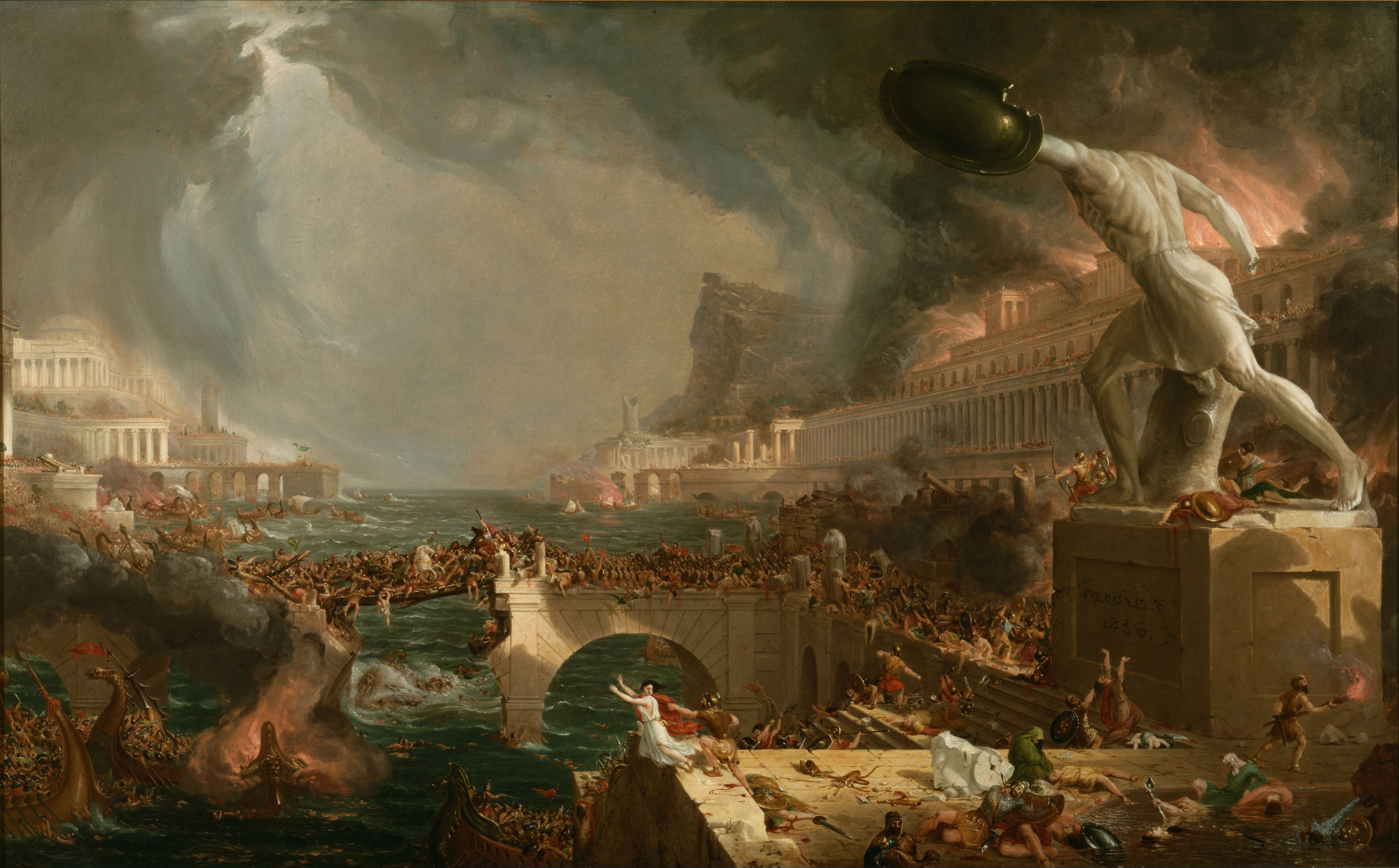
A Philosophical Happy Hour inquiring into the long-term institutional viability of democratic governance.
Why is democracy the favored form of governance in the modern world? The modern forms of democratic government emerged alongside an emphasis on individual rights, autonomy, and equality. Therefore it seems, at the root of such emergence, we find beliefs both about human nature and the good: namely, that human beings will tend naturally towards the good, such that even periodic errors will eventually be self-corrected by the democratic process. In other words, a moral code does not need to antecede democracy; it will result from it.
On the contrary, argues Fr. Norris Clarke in this essay, democracy depends upon a normative code which stands independently of that process. He claims that a democratic society cannot endure by procedures and institutional arrangements alone. Rather, any democratic order requires substantial majority of citizens actually to accept and practice some common moral code. Otherwise political life spirals into conflict between differing self-interests, requiring ever greater extrinsic coercion to hold society together. Thus democracy decays toward a police state—which is already to admit that it is no longer governing through the character of free citizens.
What Antecedes Democracy?
Fr. Clarke pushes his argument further still: that is, even if democracy requires shared ethical norms, it cannot simply legislate those norms into existence. A regime committed to the freedom and equality of its citizens cannot, by its own principles, compel inward moral conviction without ceasing to be genuinely democratic. This unveils a deeper tension: democracy seems to require moral formation, yet it cannot itself suffice as the source of that formation.
Fr. Clarke’s points out that such a moral code has historically depended upon some transcendent or religious grounding capable of lending to ethical life genuine authority, rather than leaving it at the level of individual preference. This brings us to the central question for our discussion. If Fr. Clarke is correct, then democracy is not simply good by virtue of individual rights, autonomy, or equality; rather, its goodness is derived from the moral code which antecedes it. As such, it is fragile, utterly dependent upon the widespread acceptance of that code—against the erosion of which it can do nothing.
The Viability of Democracy
Thus the question: can democracy actually remain a viable governmental system absent some religious or otherwise transcendent moral code? And if it cannot—does this mean that democracy itself is a weak form of government?
In some sense, democracy has proven a remarkably successful form of government, in terms of the countries that have flourished under an at-least-partial democratic modality. But is that success coincidental to democracy? Has that been nothing other than the fact that democracy, when operating under a shared moral code, governed primarily by “getting out of the way” of its citizens?
Perhaps democracy is indeed among the best practicable forms of government in the modern world—but perhaps only in the rare historical occasion that persons of strong virtue and shared ethos form a significant portion of the populace. That is, democracy seems to presuppose something it cannot provide. What, then, is the benefit to it when the populace needs authority for its own good?
The Power of the Majority?
Come have your voice heard this Wednesday (22 April 2026, from 5:45-7:15+ pm ET)—but do not expect to vote on anything—as we read Fr. Clarke’s essay and contemplate the future viability of democratic governance, considering these and other questions:
- Can a democratic form of government produce the moral order it needs, or must that order already exist before that democracy can function well?
- What does Fr. Clarke mean by a “normative” moral code, and why would democracy be unable to produce it for itself?
- Must the moral code antecedent to democracy be religiously or transcendently grounded, or could a secular equivalent suffice?
- Does the historical success of modern democracies prove the strength of democracy itself, or only the survival of older moral and religious inheritances?
- If democracy depends upon a virtuous and well-formed people, is it truly a strong form of government—or only a fragile one that has had the appearance of success because it occurred under unusually favorable conditions?
philosophical happy hour
« »
Come join us for drinks (adult or otherwise) and a meaningful conversation. Open to the public! Held every Wednesday from 5:45–7:15pm ET.
mailing list join live
Leave a Reply