
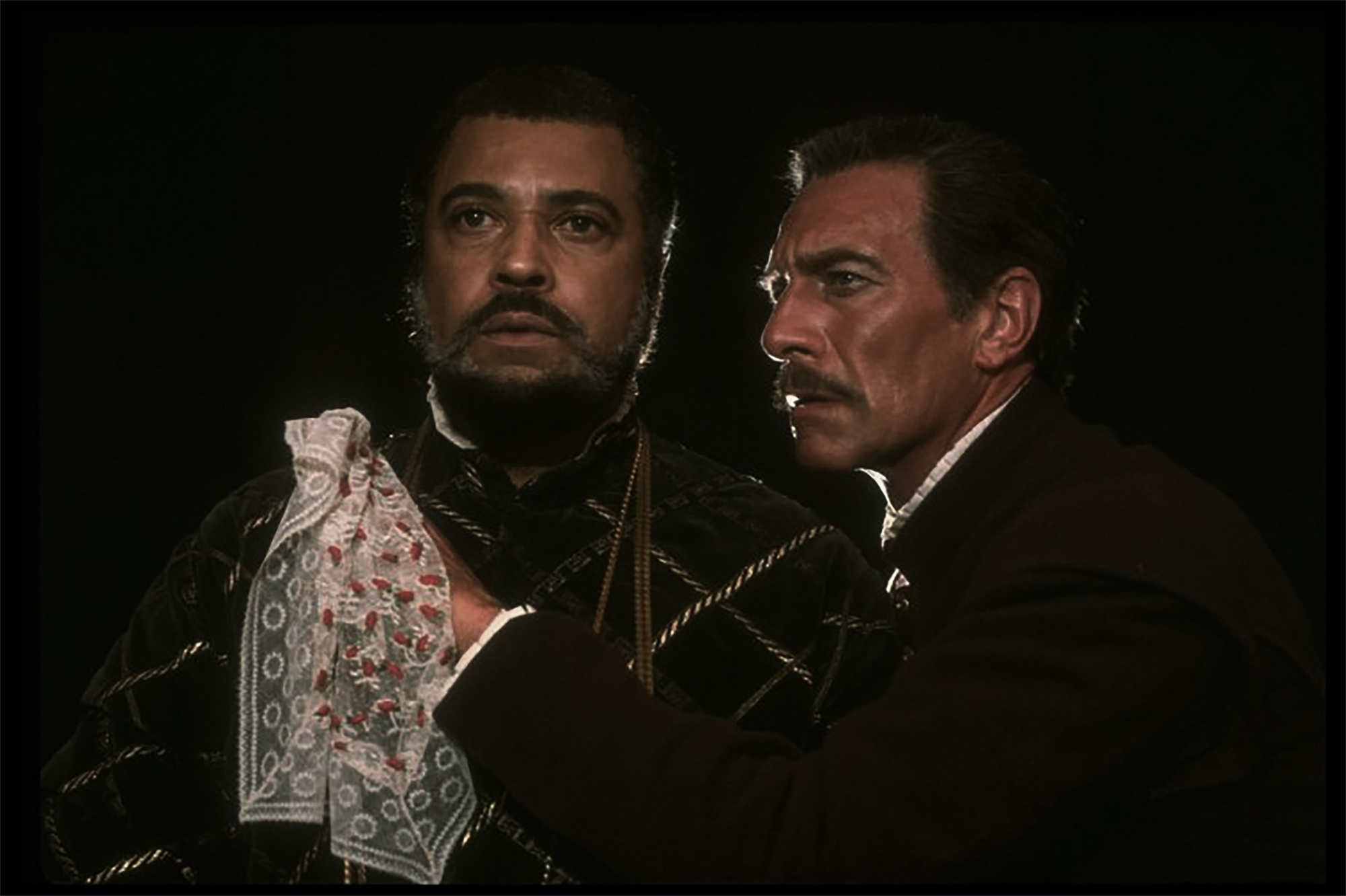
A Philosophical Happy Hour on the reasons for and nature of trust, distrust, and the consequences of breaking it. Image: Christopher Plummer as Iago and James Earl Jones as Othello (Requiescant in Pace).
Trust today seems a quality lacking and, yet for which there is great desire. We do not trust our politicians and often we do not trust our religious leaders. We do not trust our media, nor do we trust our digital acquaintances (or, if and when we do, often we are burned). In whom do we really trust? I hope, for all our sakes, that we trust our family, our friends, our spouses—but even there, we have seen trust erode over the decades. Now the demand, instead, is for transparency: which demand proves our lack of trust.
I think we often lose a good quality because we do not sufficiently understand it. Perhaps we can help ourselves to rebuild trust by investigating deeper what it is, and the reasons for it.
What is Trust?
By the word “trust”, we seemingly name at once an action, a relation, and a habit or belief. Indeed, the Latin words (“trust” being of Germanic origin) closest in meaning are fidere and credere: to have faith and to believe. There seems, also, to be a sense of the unrealized. We trust someone with respect to what has not yet been done; just as we have faith, and just as we hold to our beliefs. When we perform an act of trust, it seems that we cede responsibility for an action’s accomplishment to another. When we have trust, it seems that we do not doubt that other’s ability to accomplish that action.
Thus, it seems trust names both that relation itself and the two terms of it: the one trusting and the one trusted-in. But is that all it is? Is there something else to the nature of trust?
Why should we Trust?
In this 2006 article, Marie George summarizes and explains the teaching of St. Thomas Aquinas on trust (or rather, faith and belief). As Dr. George demonstrates, Aquinas gives four necessary conditions for trust:[1]
First, we must believe ourselves to be an object of the person’s concern. Second, we must think that the person is just (or generous or merciful). Third, we must think that the person is competent, that is, that he has the appropriate knowledge and ability. Fourth, we must feel near or close to the person, or at least that he is not distant.
And as George adds, a normal sign of trust consists in our willingness to ask another for something—for we ask only with the hope that the one asked may be able to grant our request. In a way, I believe this “willingness to ask” shows something important about trust: that in whatever regard we have it, we are in some sense forestalled from despair. So long as there is someone in whom we may trust, we are kept from hopelessness.
It will be worthwhile to read this article for our Happy Hour. Certainly, it seems, our trust today might be undermined by the third requirement: judgment that the person has competence. It also seems difficult to judge whether we have real closeness with one another for many reasons (which, I think, reflexes into the first condition as well).
Building Trust through Conversation
As a final point, note well how we speak always of building trust. It is not something that happens all at once, in a single moment. Rather, trust develops, piece by piece. We fit these pieces together by observing one another’s actions, yes; but most fundamentally, by continued conversation with one another.
So please join us this Wednesday (18 September 2024) for our Philosophical Happy Hour (5:45–7:15pm ET; latecomers welcome!) as we engage in a truly honest, just and merciful, and competent conversation concerned with one another’s well-being.
philosophical happy hour
« »
Come join us for drinks (adult or otherwise) and a meaningful conversation. Open to the public! Held every Wednesday from 5:45–7:15pm ET.

[1] George 2006: “Aquinas on the Nature of Trust” in The Thomist 70: 103-23.
No responses yet