
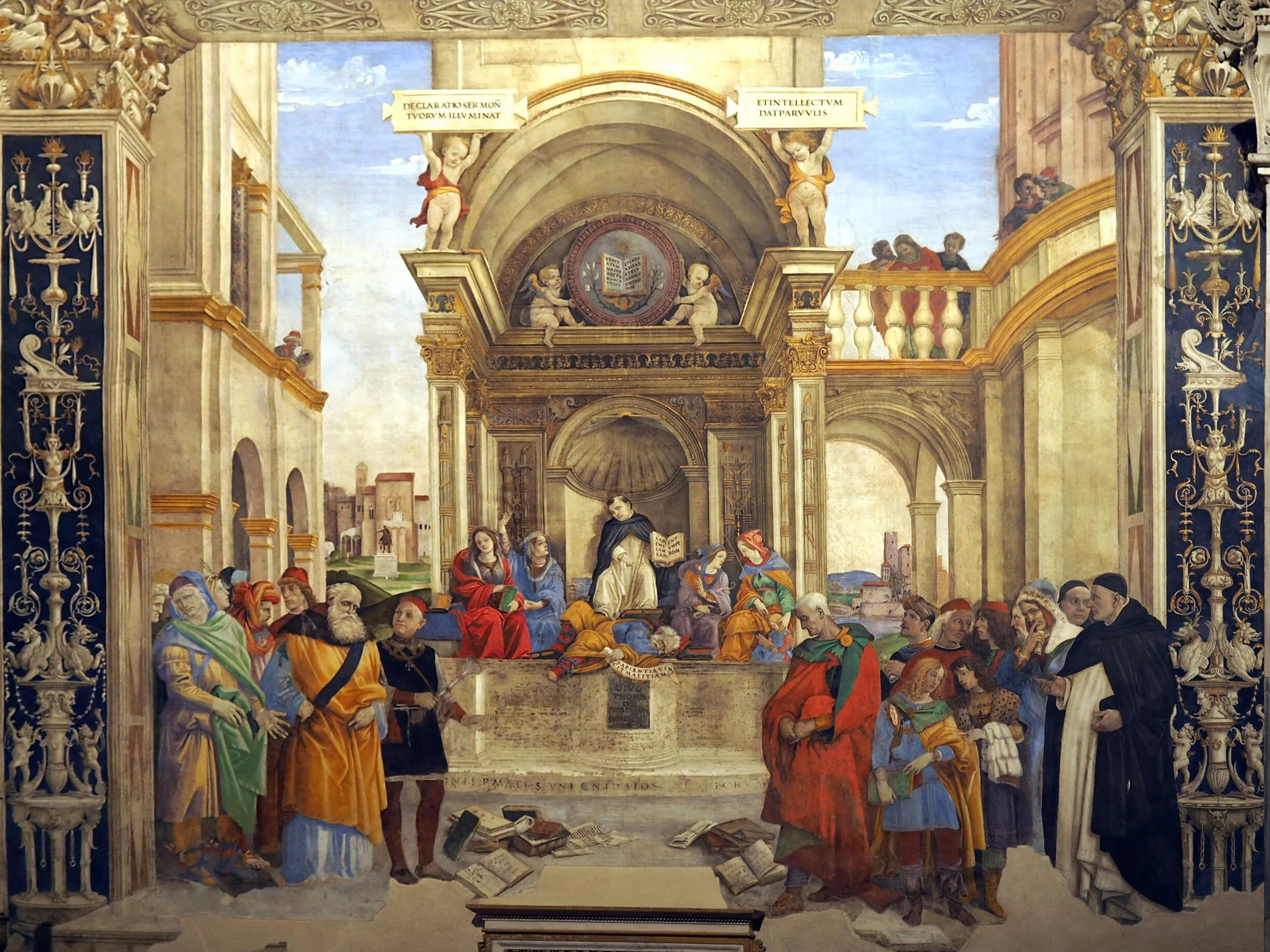
In this Philosophical Happy Hour we will turn our attention to the ever-persistent question of the relation between faith and reason.
How should we understand the relationship between faith and reason? We will explore this question through the sharp and illuminating lens of St. Thomas Aquinas in his commentary on Boethius’ De Trinitate, specifically question 2, article 3, where he asks: “Utrum in scientia fidei, quae est de Deo, liceat rationibus philosophicis et auctoritatibus uti?” (“Whether in the science of faith, which is concerned with God, it is licit to use the rationales of philosophers and authorities?”)
The Tension of Faith and Reason
The tension between faith and reason has existed from its earliest days. From Tertullian’s provocative “What indeed has Athens to do with Jerusalem?” (c.208AD, in his Prescription against Heretics, c.7—in which he explicitly opposes pagan philosophy to Christian faith) to the efforts of the Scholastics to reconcile Aristotelian philosophy with Christian doctrine, thinkers have wrestled with whether reason aids faith or undermines it. Modernity, especially from the Enlightenment onward, has often caricatured faith as explicitly contrary to reason and philosophy or science as the liberator of the human being.
Yet St. Thomas, in many of his works but especially this text we are looking at here today, presents a more careful and integrated approach—one which does not collapse the two, but seeks their right ordering.
Uses of Reason in Knowledge by Faith
In this brief article, St. Thomas outlines three principal ways that philosophy can be legitimately and even fruitfully employed within theology (that is, within the act of “knowing by faith” — in fide scire):
- First, for the sake of demonstrating those things that are preambles to faith and that have a necessary place in the act of knowing by faith: such are the truths about God that can be proved by natural reason—such as that God exists, that God is one, and other such notions concerning either God or His creatures, subject to philosophical proof, which faith presupposes.
- Second, for the sake making better-known, by certain similitudes, those things which belong to faith; as Augustine in his book, On the Trinity, employs many comparisons taken from the teachings of the philosophers for the purpose of revealing the Trinity.
- Third, for the sake of resisting those who speak against the faith, either by showing their statements to be false, or by showing that they are not necessarily true. Nevertheless, in the use of philosophy in sacred Scripture, there can be a twofold error.
Taken together, these uses of philosophy do not “prove” the mysteries of faith in the strict sense, but they serve faith: they prepare the soul, enrich its understanding, and defend it against falsehood. Do they also show faith itself to be reasonable?
Questioning the Relation
This Wednesday (30 April 2025 from 5:45–7:15+ PM ET) join our Philosophical Happy Hour to investigate the relation of the philosophical and the theological as we seek a deeper understanding of faith and reason! Open to the public, links below.
philosophical happy hour
« »
Come join us for drinks (adult or otherwise) and a meaningful conversation. Open to the public! Held every Wednesday from 5:45–7:15pm ET.

No responses yet