
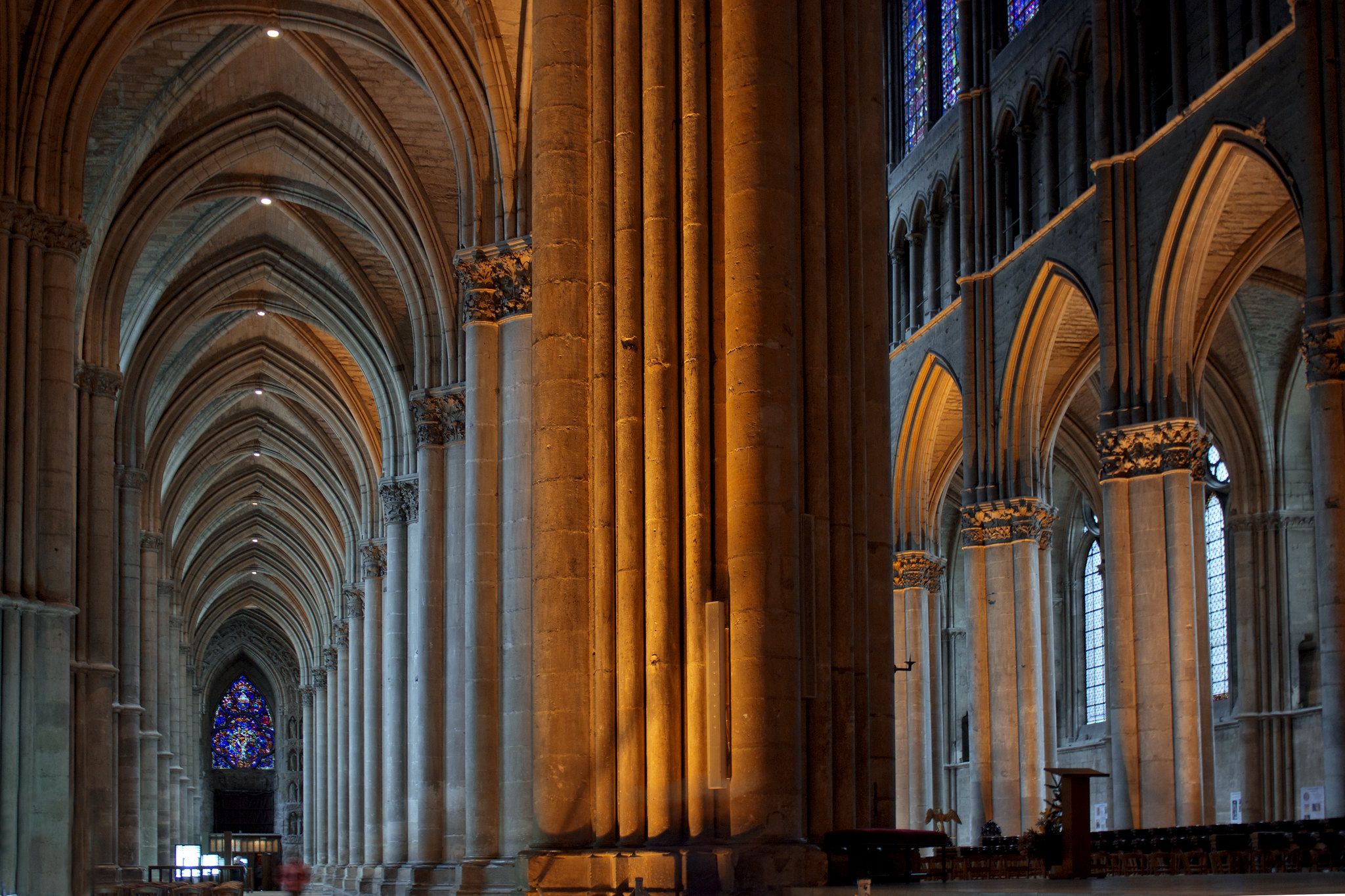
When we think of a Gothic cathedral, we tend to think upward: the spires of Cologne, the ascendant arches of Reims or Amiens; or the upward-soaring buttresses of Notre Dame de Paris; or the way one’s eyes are drawn along the high vault of a nave to the transepts or chancel. Perhaps we think of stained-glass windows, or high altars; ornate carvings and statues high above the ground; we think of the mind and prayer raised up toward the heavens.
The Labor of Laying Foundations
But such massive, impressive, and long-lasting structures rely upon foundations unseen. These cathedrals were not simply built upward—first, they were built downward. Their grandeur rests upon deep and deliberate work beneath the surface: carefully sited, soils studied and tested, and foundations poured deep and wide.
The foundation of a Gothic cathedral was not a mere platform, but a science and an art of its own. Master masons first surveyed the ground, assessing its consistency, its drainage, its resistance to frost and pressure. If the soil was soft or uneven, it would need reinforcement; if it retained water, channels and gradients had to be engineered to carry it away. Trench foundations—sometimes ten, fifteen, or even twenty feet deep—were dug with hand tools, lined with rubble and coarse stone, and bonded with lime mortar. These footings were often wider than the walls above, flaring outward to spread the load and stabilize the enormous weight that would be placed upon them.
Much of this painstaking work would never be seen again. Once the ground was filled and the first courses of stone laid, all that patient labor was buried. But without it, the cathedral could not rise. And without continued attention to the integrity of the foundation, even a finished cathedral could weaken and collapse. Foundations are not a phase—they are not something to be forgotten or ignored. Rather, they are necessary continual conditions of the whole.
Lessons from History
There is a lesson here for those of us engaged in higher education—especially in the work of building new institutions when so many seem to be falling apart. What we face today is not simply a crisis of curriculum or content, but a collapse of the very structures—the intentions, the goals, the foundational principles—that once upheld the pursuit of truth. Truth! A good that, among all things given to earthly beings, can be touched by human beings alone. And contact with the truth is threatened by the demise of our institutions.
The Lyceum Institute was founded in response to this collapse. Our intent, however, is not to replicate what once was, nor to mimic what still is. We are striving to build anew an institution capable of bearing the intellectual and cultural weight that our age demands. This means that we, much like the builders of the great Gothic cathedrals still standing today, must take our time to lay carefully and thoughtfully the foundations.
Our foundations are not poured in concrete or rebar. They are dug in the habits of inquiry, memory, and order. They are reinforced through the disciplines of logic, grammar, rhetoric, and philosophy. They are laid stone by stone in the study of Latin and Greek, in the restoration of thoughtful dialogue, and in the commitment to intellectual virtue.
Like the builders of Chartres or Cologne, we are not laying these stones in the expectation of immediate results. We are building for generations and shaping a structure that must outlast us, an institution built to weather cultural storms, an edifice that will remain standing when others have burned up their cheaply-bought attention.
Solidity in a Time of Change
This is why our campaign employs no spectacle or a false urgency. It appeals to those who understand the value of patient, hidden, foundational work, to those of you who know that building something worthy of the tradition it inherits—and of the future it hopes to serve—requires discipline, clarity, persistence, and care.
Digging the deep trench in which to lay our foundations is not glamorous; laying the simple unadorned stones that support the edifice is not a work of fine beautiful art. But it is necessary. And we are asking for your help to do this work.
Every gift to the Lyceum Institute’s Endowment Fund helps us pursue our goals: expanding our programs, supporting our faculty, and securing the institutional stability needed to endure. Your contribution becomes a part of the invisible labor that makes the visible possible.
No responses yet