
This is the third in a four-part series on the Death and Evolution of Education, which seeks to explain why we cannot rely upon the university to provide the intellectual formation necessary for the common good, but must “evolve” a new approach to learning. Part I: Introduction can be found here, and Part II: The Hostile Environment here. In this, Part III: Maladapted Universities, we explore the university’s failure to adapt to the environment. Part IV: Evolution of Higher Education will be posted 28 August 2025.
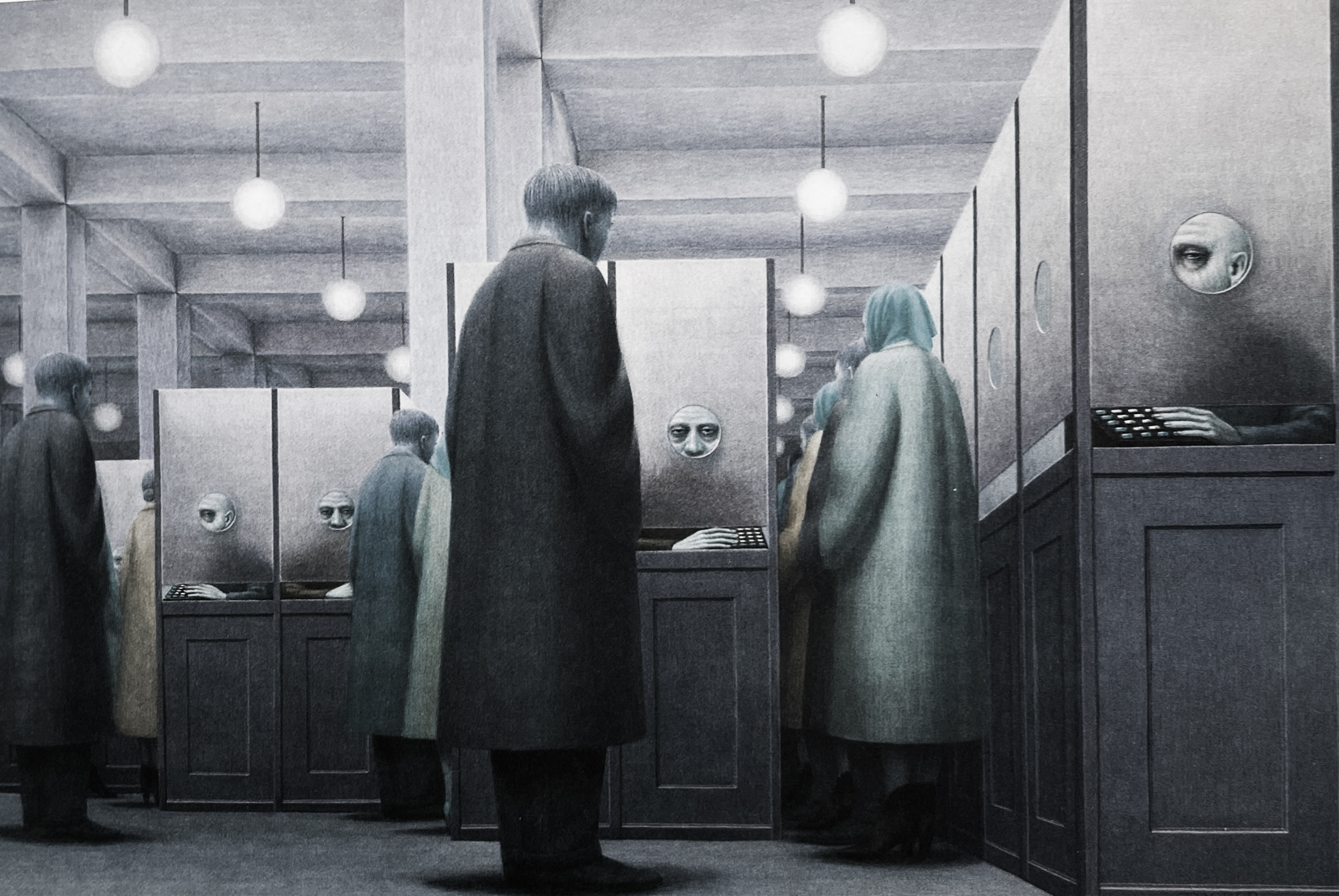
The crisis—crises?—in education identified in the mid-twentieth century concerned principally the accommodation of curricula and standards to the conduct of life in an industrial society. Put otherwise, between the early-twentieth century and the turn of the twenty-first, education quickly and progressively shifted from the refining of man to the training of men. This “training” itself underwent changes, naturally enough, as Western society’s labor became increasingly postindustrial—specifically moving from the manufacture of products to the management of information. Thus, the institutions of “higher education”—colleges and universities—became increasingly ordered to training for this managerial society. The environment was changing and the directions taken by educational institutions changed accordingly; lower targets, increasingly, became the aim. In the meantime, a continued tacit recognition for prudence allowed non-technocratic learning to continue—under which learning alone are the conditions for prudence cultivated—albeit in ever-narrowing margins of the university. Today, these margins are becoming razor-thin.
But these changes, well-documented and rightfully but largely ineffectually challenged by traditionally-minded educators again and again, are not the maladaptation of the university I have here in mind. Though they are indeed adaptations, they are also, no doubt, signs of the university’s failure to adapt appropriately to the environment, even for hitting its lowered aims. Most training for managerial employment—or for functioning professionally within a managerial system—is not effectively accomplished through a university education. Simultaneously, the inefficient education in specialized fields crowds out the general intellectual development most germane to the university environment. Both the individual student and the wider societal structures of our world would be better served by on-the-job training. However, through influences too complex to trace here, the intertwined structures of bureaucracy and credentialism have allowed the university to survive by awarding degrees. These degrees today seldom signify the assessment of professors that their students have attained meaningful knowledge; rather, they signify a willingness and ability to play an arbitrary game disconnected from natural realities, a ticket that one has purchased.
Yet again, this perverse compliance with an artificial, arbitrary game is not the maladaptation I have in mind; though it, too, is a sign of that maladaptation. Not too long ago, the professor was a respected member of society, not merely for his own credentials but for the knowledge and ability he possessed, as teacher and/or researcher, as part of a knowledge-class responsible for the intellectual well-being of society. Regardless of his specialty, he was expected to have something of a liberal mind: inexpert in Plato and Shakespeare, perhaps, if his field was chemistry—but familiar with their works and the outlines of their thought. Perhaps not a master of Greek and Latin, if a teacher of physics, but competent at expressing himself at least in English. Conversely, the professor of philosophy or literature may not have understood precisely the calculations used by the physicist, or the experiments run by the chemist, but they were appreciated as the works of his colleagues and a matter of interest nonetheless. Together, they worked to form their students’ minds in arts of reasoning and sciences of understanding. Through not only their individual expertise but also their collective assessment, the education provided students a path to a genuine liberality of thought. Again in a history too complex to trace, the college became fragmented; the university ceased to be unified. Though there always were tensions among faculty—both within departments and between departments—these tensions were a healthy part of the intellectual atmosphere. At some point, however, professors ceased to maintain those tensions; they slackened, atrophied, decayed. The professor withdrew: first into his own department, then into himself. He became a facilitator of the technocratic, bureaucratic system. Resolute, perhaps, on continuing to uphold the dignity of his task—but the unjustly condemned prisoner lives behind bars no matter how straight he keeps his spine.
Still, this technocratic gulag is not the maladaptation I have in mind, sign though it is of a gravely-ill entity. Many might, in seeing these symptoms of the university’s ailing condition—its marginalization of liberal learning, its subservience to technocracy, its replacement of knowledge and love of wisdom with information and efficiency of training—and insist the treatment is, simply, to reverse course. “Let us restore a core curriculum! Let us eliminate the professional training programs! Let us cease to train managers and return to educating the best minds in the highest things!” It is a romantic, idealistic, and utterly impractical dream. But not only does this dreamy-eyed longing for a bygone intellectual institute wear blinders to the reality of today’s university; it is itself a symptom of the ailment that produced the current conditions in the first place. Treating the symptoms of a disease undiagnosed has perhaps, at times, alleviated our suffering. But, doing nothing to cut out the root cause of rot, it has allowed the disease to spread and worsen.
We know the purpose of education. It is not to train individuals for work in the world. It is to enable students to flourish, to grow in virtues of the intellect—especially knowledge—and thereby to bring good into the world wherever they go. Truly well-educated students are not instruments of society; they and their minds especially are the fundaments upon which a healthy society is built and through which the nature of that society is determined.
But the relations constituting society, unlike those between the parts of a building, are fluid. They change not only year after year, month by month, but by weeks, days, sometimes even hours. Though they take many particular forms, these societal relations are all in principle communicative (and we may even say linguistic or postlinguistic—but that is another difficult issue that would take us in a different direction). Thus, as the means for communication change, so too do our societal relations. We need not repeat the histories of how societal changes followed in the wake of the printing press, the newspaper, the telegraph, the telephone, the television—or the internet, a change so swift and profound we have only the slightest clue of what it has done to the fundaments of society. And yet, somehow, amidst the rapidly unfolding changes in communication technology, we have insisted upon maintaining the same patterns, structures, and institutions of education, as though they had been simply perfect—as though simply perfect education could ever exist.

Yet the paideia of antiquity, Plato’s Academy, Aristotle’s Lyceum, the Roman schools of oratory; the cathedral school, the Scholastic university; the private schools of the Renaissance; the Enlightenment university, the great research institutes of the twentieth-century—none of these have ever been perfect, neither in their methods or curricula nor in their adaptation to the conditions of intellectual life. Aiming at such perfection, arguably, makes one’s institute an enemy of the good. What each had in common (at least in part with the Renaissance and Enlightenment, but undoubtedly in the earlier institutions) was a sense of continuity between the life of learning and the world outside one’s school. Education was not a phase of one’s life but a habit of being. This sense of continuity and the habit of education has most certainly been lost from all but the rarest of institutions—and even there, we find often a fracture, a sense of the school contra mundum. One can see the erosion of continuity throughout the twentieth century. The increase of geographical and social mobility—the ability to travel great distances with relative ease, for relatively universalized costs and standards of living, the transferability of trained skills, the de-emphasizing of family—allowed life to be normatively divided into a building-block conception of time and place, and subsequently of the self. Education, as such a modular building block, might therefore prepare one for the next phase of life; but it does not continue in virtue or practice.[1]
To state the point succinctly: the adaptations made by higher education to accommodate the changes reshaping the world over at least the past century, consequent to technology, betrayed the fundamental purpose of higher education. To survive in this environment, higher education abandoned pursuit of the end to which it is ordered by nature. One can, again, cry out that we must simply “go back!” that we must “return!”—to no effect. For it is not simply a matter of dismantling the technocracy, the world-wide-bureaucracy, the (post)industrial-capitalistic complex, of re-shaping communities, and markets, and the workplace. No, even all that would not be enough to “go back”. It is not enough to ban smartphones and laptops in the classroom. One can and should ban them, indeed, but it is not enough. One would instead have to destroy the smartphone, the laptop, the desktop, the television, the tablet—the internet as a whole, not just in the classroom but the whole world. Even less likely, one would have to regulate every usage of such technology that has led us to the conditions in which we find ourselves today. For it is not simply the intrusion of this technology upon the classroom, upon the university, which has made it so difficult to provide a real education. It is that this technology, and those technologies upon which it has been built, in fact structure the rest of the world. The environment they produce is persistently and actively corrosive to the virtues of an educated mind.
Or to put this otherwise: it is no longer enough to raise up a child in the right way. Teach him grammar, logic, rhetoric; form his moral imagination with good literature, stories rich with virtue; send him off to the rare college where he may learn the deeper things. He will live better, no doubt, than someone deprived of such learning. But he too will find himself immersed in a blurring confusion of real and unreal, not only through the digitally-connected devices inevitably he will have to use to navigate society but also among his peers, colleagues, friends, and loved ones. The extraordinary individual might endure such circumstances and maintain the virtues of his mind, but his will often be a lonely existence.
The university today stands ill-adapted to these conditions. Already it struggles to provide the opportunity for developing genuine intellectual virtue. A rather radical and rapid evolution would seem necessary.
[1] That is, one might continue to be trained; but the exposure to liberal learning of a genuine kind, even of the marginalized sort still extant today, has lost its vitality. It has been relegated to a “piece” of the educational puzzle, rather than the guiding principle of the mind’s development.
No responses yet