
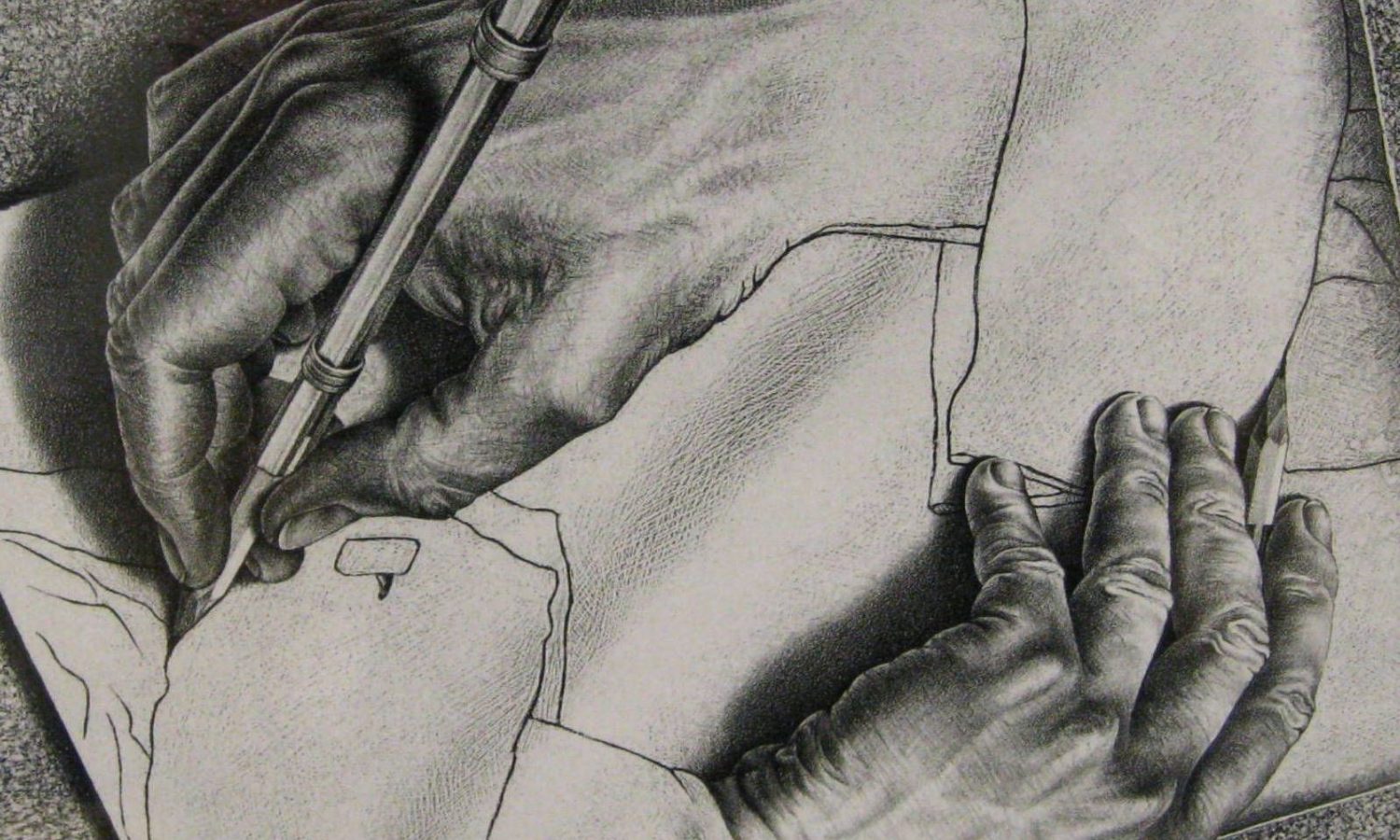
A Philosophical Happy Hour on the role of paradox in carrying out investigations of nature, humanity, and being.
“A paradox”, writes the Thomist philosopher Frederick D. Wilhelmsen, “is the tension existing between two apparently opposed propositions which cross one another and thus find themselves at peace.”[1] Wilhelmsen contrasts the paradoxical with the dialectical—understood in the sense employed by Hegel—as both are concerned with tension, but the “dialectic resolves tension by contradicting the oppositions found in opposites and by seeking a higher unity. A dialectical thinker is obsessed by tension, but he cannot stand to live within it. This is true of all orders of the real. Paradox, however, achieves a tension and then maintains it!”[2]
The topic of paradox has been raised often by thinkers concerned with the over-rationalization typical of modernity and the Enlightenment. But is a paradox, as Wilhelmsen suggests, a peacefully maintained tension between two opposed propositions? Is the tension something real—in the nature of things themselves, or rather something in us, and how we see the objects signified?
Examples of Paradox
Many a skeptic might, in encountering an author employing paradox in such contexts, react negatively: throwing hands in the air, sighing heavily, discarding what seems like poetry when it was hoped science or reason would be found. What good is an unresolved tension? How does it help us reconcile the faithful behavior of Abraham—as does Kierkegaard in his Fear and Trembling—to see the willingness to sacrifice Isaac while believing in God’s promise (that he would be father to great multitude) as a paradox? Or to find Slavoj Žižek explaining that ideologues’ ability to recognize the absurdity of their beliefs while maintaining them as a kind of necessity is a paradox? Or the very paradoxes which seem at the heart of Christianity: “He who wishes to save his own life, will lose it; while he loses it for my sake, will discover it” (Mt. 16:25)?
Other examples of paradox are commonly invoked, but less weighty. I think here of the “liar’s paradox”: the claim, that is, that saying, “I am a liar” involves in an irresoluble tension. If the statement is true, then its claim is false. But there are multiple ways in which this paradox can be easily dissolved: for one, that the claim, “I am a liar” refers not to something essential, but habitual, and therefore not something necessary—allowing that one can say what is true. For another—even if it were strengthened to, “Everything I say is a lie”—one can simply deny the veracity of the premise: lies are a certain defect from the truth, but there has to be some truth from which the lie can be deficient. A statement entirely out of correspondence with what is would be entirely incoherent.
But although such supposed paradoxes are easily-dissolved, they nevertheless show us something true about what paradoxes ought to do, to meet the criteria given above by Wilhelmsen: that is, they ought to point us towards something that, despite being irresoluble in some way, nevertheless illuminates something as true.
Explaining Paradox
We face, then, a twofold challenge in explaining paradox. On the one hand, there is the challenge of stating how it cannot be resolved without constituting a contradiction. On the other, we face the challenge of explaining how—without dissolving the essential tension—it can convey a truth.
Moreover: does it convey a truth that cannot be conveyed otherwise? (Why else use it? Is it rhetorically effective, somehow?) Or we might ask: is paradox essential? If so (to add a third challenge), how do we explain it to the sceptic? Are there differences between the paradoxes of Žižek and Christ? Between Christ and the Buddha or Laozi?
Discussing Paradox
Please join us this Wednesday (21 August 2024) for our Philosophical Happy Hour (5:45–7:15pm ET; latecomers welcome!) as we try to understand this gordian knot. Those wishing for further stimulation might read the chapter from G.K. Chesterton’s Orthodoxy, titled, “The Paradoxes of Christianity”, or Frederick D. Wilhelmsen’s “Paradoxical Structure of Existence” or investigate the use of paradox in the works of Kierkegaard, Žižek, or any others you believe should be brought into the conversation!
philosophical happy hour
« »
Come join us for drinks (adult or otherwise) and a meaningful conversation. Open to the public! Held every Wednesday from 5:45–7:15pm ET.
Open to the Public. Anonymous users may listen only.

[1] 1970: The Paradoxical Structure of Existence, 70-71
[2] Ibid, 75.
No responses yet