
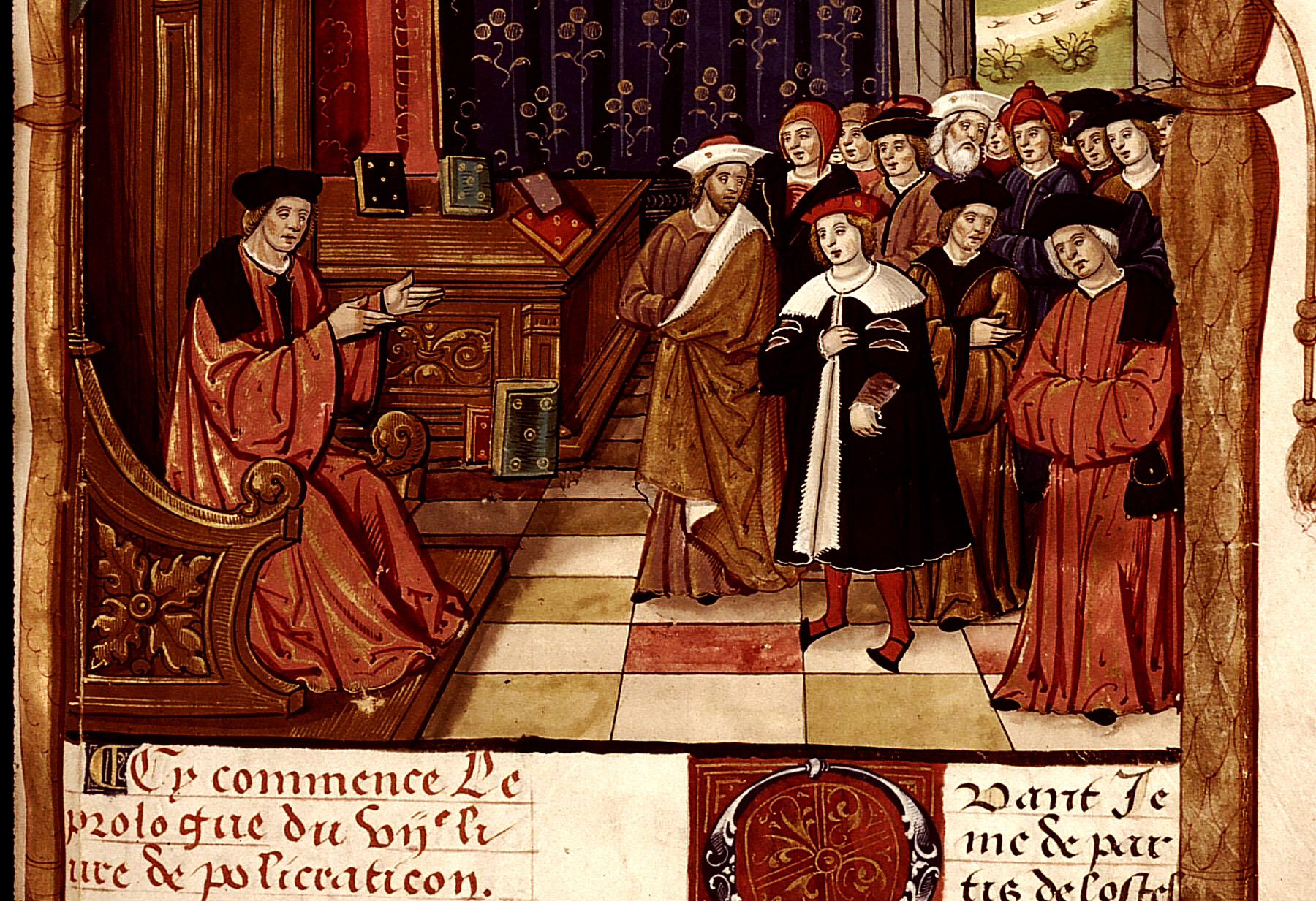
A Philosophical Happy Hour concerning the problem of universal education: should we educate everyone? To what extent? How? Why (not)?
If we look today at the results of universal education, particularly over the past century, we may think that its institution was a mistake. The results are those of decline. High test scores in a district seldom reflect genuine intellectual accomplishment—only, in fact, lowered standards. For decades, it has been the norm for an American high school graduate to attend college. This norm has likewise degraded the quality of higher education—and the elective curriculum (i.e., degree majors) has resulted in a professionalization of learning that diverts it from the proper object of study.
But opposition to universal education—at least, in the broadly democratized sense just outlined—did not appear in the past five or ten years. One can find the opinion, or at least strong hesitation about the extent to which the broader populace should be exposed to higher learning, voiced even in the ancient and medieval worlds—by thinkers no less than Plato and Aristotle, Augustine and Alfarabi, and even, in at least some sense, in Thomas Aquinas. Many thinkers of the Renaissance and Enlightenment gave voice to an elitist position. Nietzsche believes the masses incapable of true depth. Leo Strauss and his student, Allan Bloom, believed only a few could (or would) truly benefit from a liberal education. Is this true? Does the experiment of universal education bear out the truth of the criticisms? Or has our attempt at universal education provided only a living strawman?
Governance, Education, and the Common Good
“Then it’s impossible,” says Plato’s Socrates in The Republic (494a), “that a multitude be philosophic.” The mob, the many, the hoi polloi—the unthinking masses. People who watch Dancing with the Stars or The Masked Singer; who, if they read, pick up airport fiction—cheap spy thrillers, romance novels. Fans of Adam Sandler. Is it worthwhile to provide educational opportunities to such? To go out of one’s way to teach those with no desire to learn? Or should we sneer at them, mock them, cast them off into their vapid entertainments? Should the genuine philosopher condescend to their level and, in so doing, debase himself? Consider this from Friedrich Nietzsche’s Beyond Good and Evil (§213, emphasis mine):
there exists an order of rank of states of soul with which the order of rank of problems accords; and the supreme problems repel without mercy everyone who ventures near them without being, through the elevation and power of his spirituality, predestined to their solution. Of what avail is it if nimble commonplace minds or worthy clumsy mechanicals and empiricists crowd up to them, as they so often do today, and with their plebeian ambition approach as it were this ‘court of courts’! But coarse feet may never tread such carpets: that has been seen to in the primal law of things; the doors remain shut against such importunates, though they may batter and shatter their heads against them! For every elevated world one has to be born or, expressed more clearly, bred for it: one has a right to philosophy – taking the word in the grand sense – only by virtue of one’s origin; one’s ancestors, one’s ‘blood’ are the decisive thing here too. Many generations must have worked to prepare for the philosopher; each of his virtues must have been individually acquired, tended, inherited, incorporated, and not only the bold, easy, delicate course and cadence of his thoughts but above all the readiness for great responsibilities, the lofty glance that rules and looks down, the feeling of being segregated from the mob and its duties and virtues, the genial protection and defence of that which is misunderstood and calumniated, be it god or devil, the pleasure in and exercise of grand justice, the art of commanding, the breadth of will, the slow eye which seldom admires, seldom looks upward, seldom loves…
Though one must always read Nietzsche with caution (as he loved to hide his true meanings behind an esoteric veil—which esoteric veil itself suggests an attitude of elitism), this passage ostensibly claims that the many are by their innate disposition not only incapable of philosophic inquiry but ought to be prohibited from it. Rather, it is suggested, the truly philosophic are responsible for the governance of others. What then, should be the education given to the many? Should they receive any? Should theirs be mere training for utilitarian purposes?
Dignity and the Rational Soul
By contrast, we might look at some other thinkers—such as Hugh of St. Victor (c.1096—1141) in his Didascalicon or John of Salisbury (c.1117–1180) in his Metalogicon. These Christian authors, the former a member of the Canons Regular of St. Augustine (centered in the Abbey of Saint Victor near Paris) and the latter the bishop of Chartres, hold to a kind of “humanism”: not one that makes man the supreme end of all things, but one which sees in the human rational soul an inherent dignity to be pursued. As John writes in his first chapter:
All who possess real insight agree that nature, the most loving mother and wise arranger of all that exists, has, among the various living creatures which she has brought forth, elevated man by the privilege of reason, and distinguished him by the faculty of speech. She has thus effected, by her affectionate care and well-ordered plan, that, even though he is oppressed and handicapped by the burden of his earthy nature and the sluggishness of his physical body, man may still rise to higher things. Borne aloft, so to speak, on wings of reason and speech, he is thus enabled, by this felicitous shortcut, to outstrip all other beings, and to attain the crown of true happiness.
In other words: the human being, by nature, stands disposed to the highest things. Our material disposition may make us sluggish. But it does not drag our spiritual, intellectual, rational nature into an inescapable mire. The “higher things” stand open to us in principle. This openness does not entail that everyone will be able to attain the heights of intellect in fact. But does this fact stand in the way of striving? Consider Hugh:
Others… because they know that they are in no way able to compass the highest things, neglect even the least, and, as it were, carelessly at rest in their own sluggishness, they all the more lose the light of truth in the greatest matters for their refusal to learn those smallest of which they are capable. It is of such that the Psalmist declares, “They were unwilling to understand how they might do well.” Not knowing and not wishing to know are far different things. Not knowing, to be sure, springs from weakness; but contempt of knowledge springs from a wicked will.
Are we caught—trapped—between an unrealizable ideal and a harsh reality? What obligations do we have, in discovering the truth, to communicate it to our fellow human beings?
What is the Problem, what is the Lesson?
Join us this Wednesday (11 June 2025 from 5:45–7:15+ PM ET) as we ask: who deserves education? How should it be provided? What should be taught, to whom, and why? Preface to Hugh’s Didascalicon. Beginning of John of Salisbury’s Metalogicon.
philosophical happy hour
« »
Come join us for drinks (adult or otherwise) and a meaningful conversation. Open to the public! Held every Wednesday from 5:45–7:15pm ET.

No responses yet